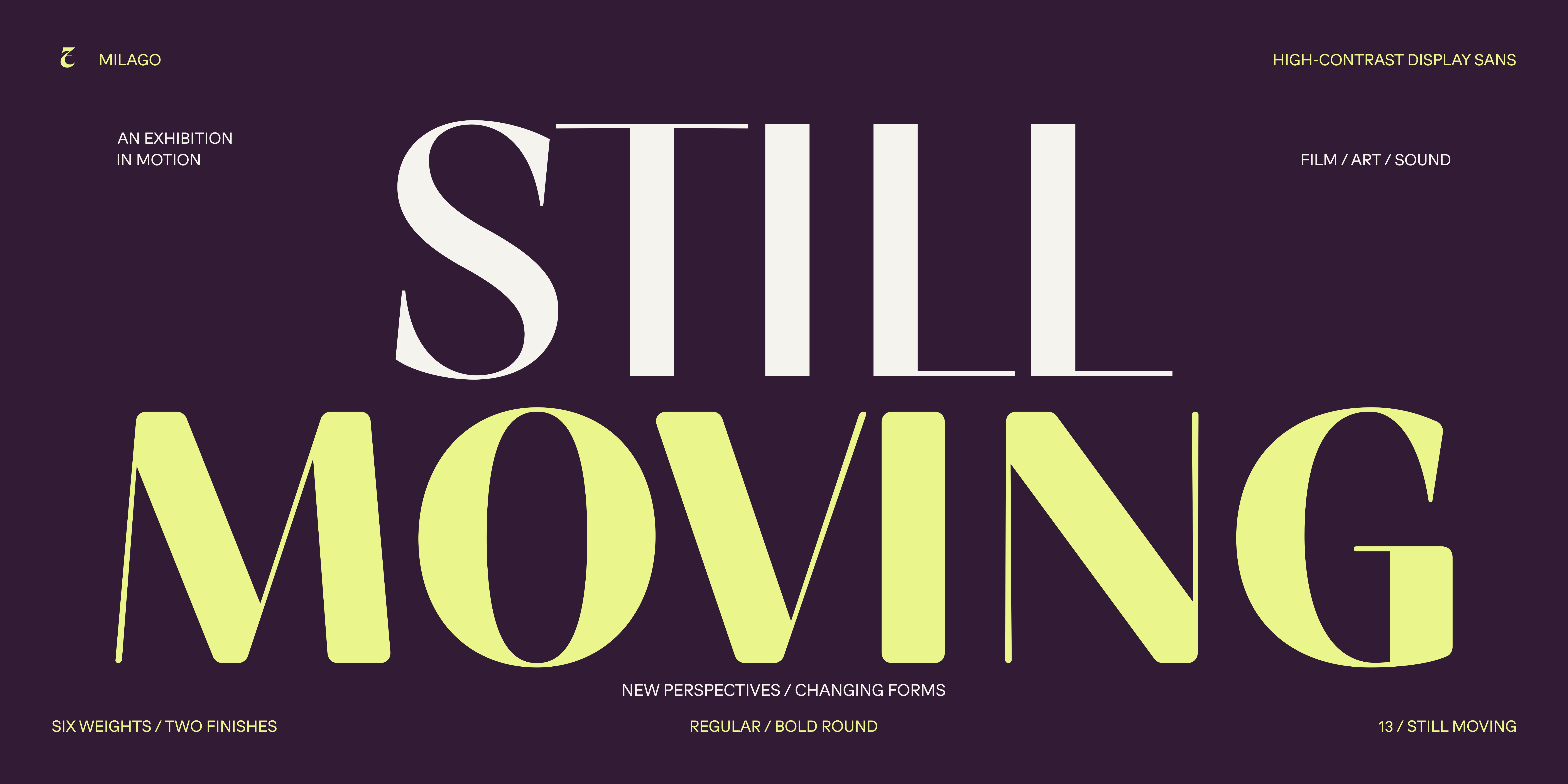
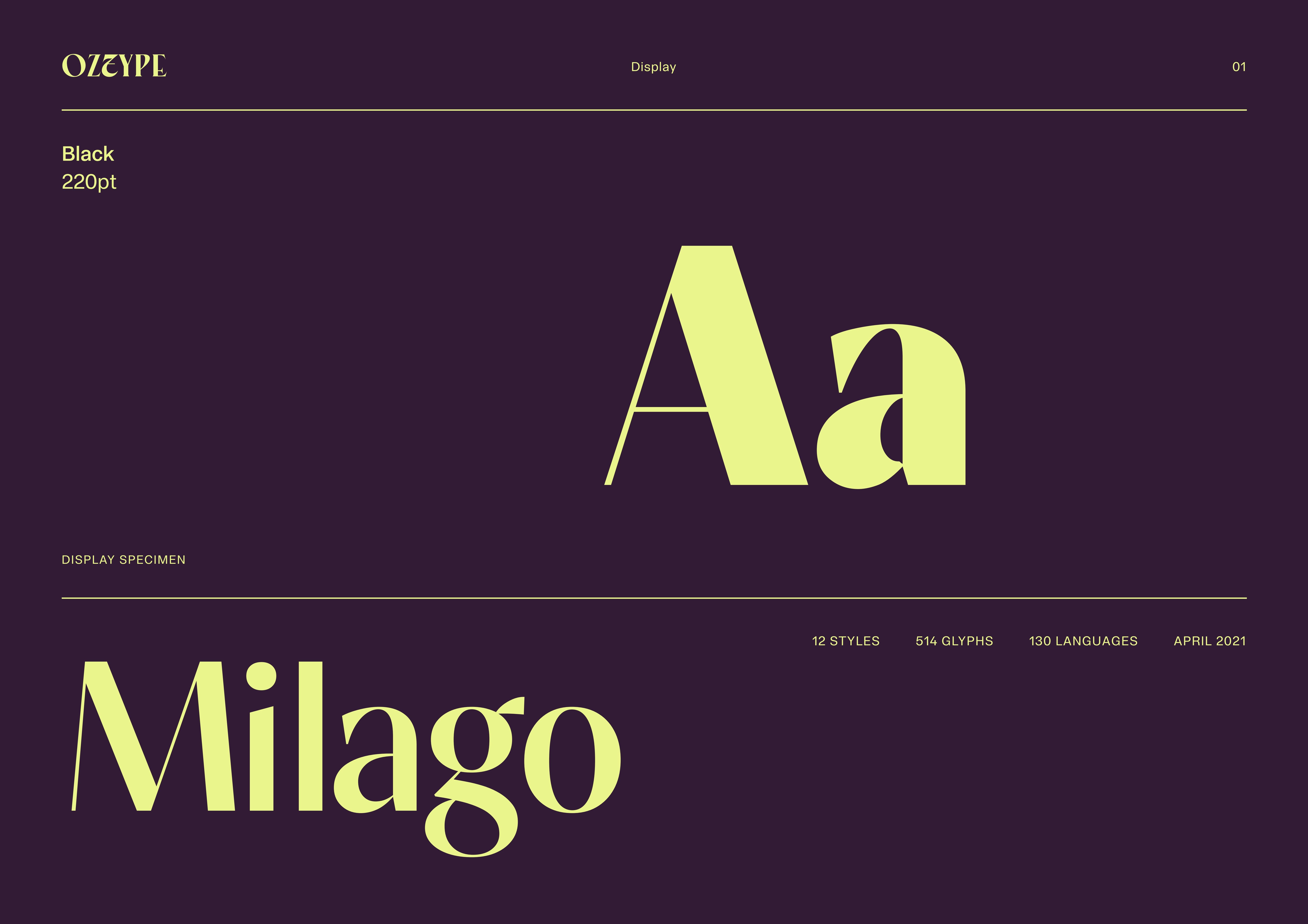
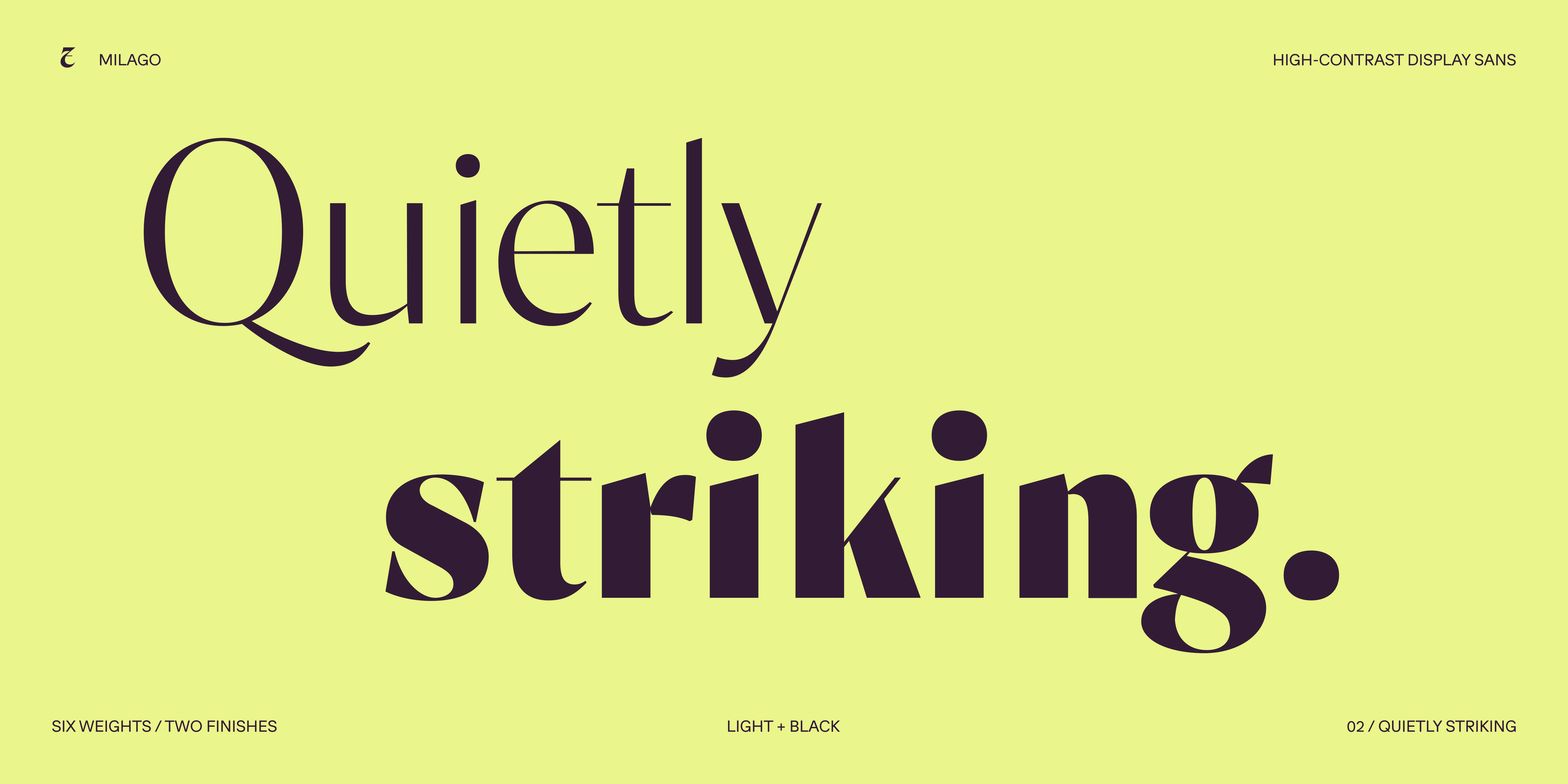
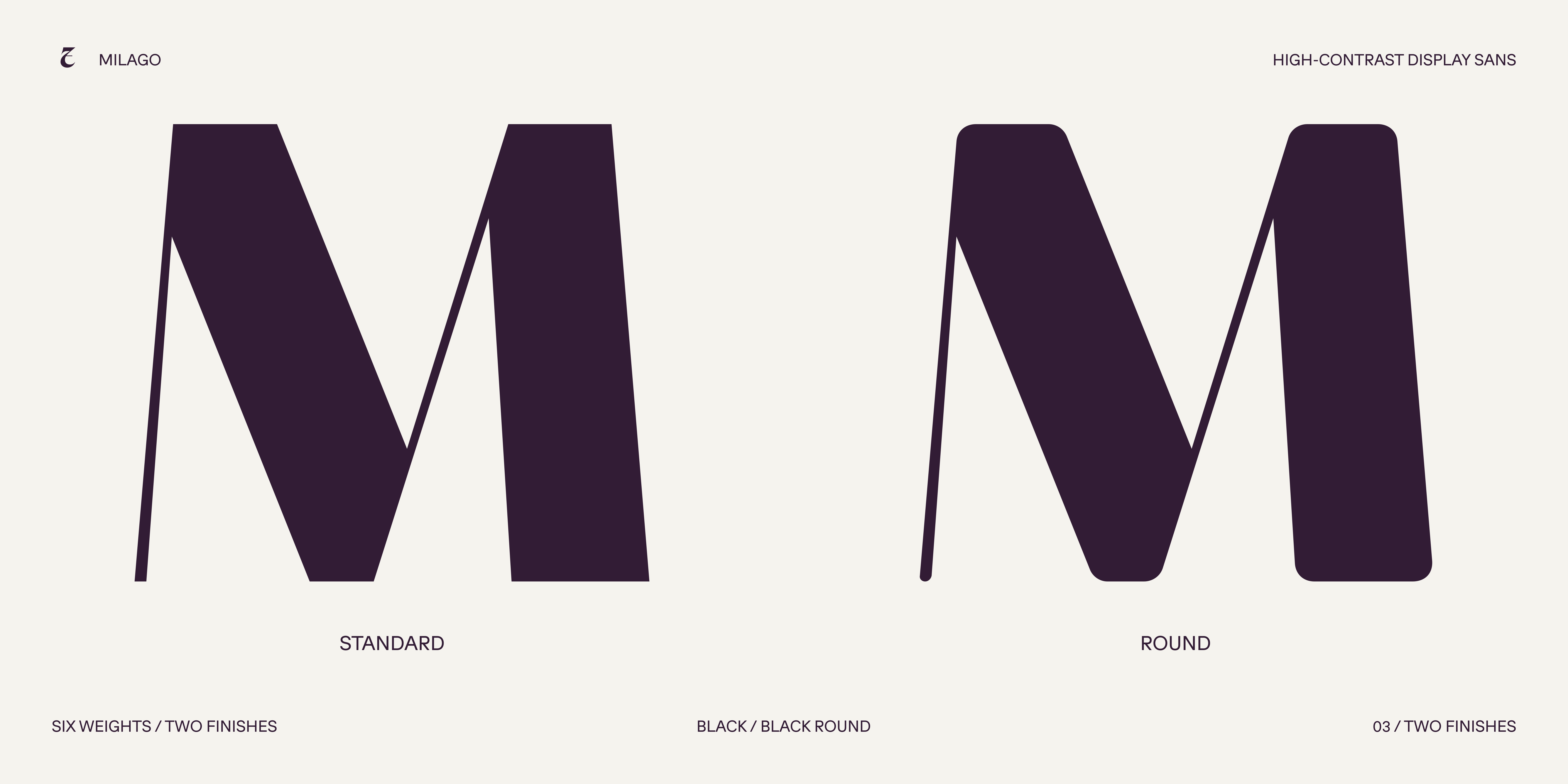
Milago

01

Type Tester

Editable
Size280px
Weightwght400
RoundnessROND0
Thin · Standard
Size285px
Leading0.92
Tracking0
Align
Flow
Vernissage
Weightwght100
RoundnessROND0
Thin · Round
Size330px
Leading0.92
Tracking0
Align
Flow
Marquee
Weightwght100
RoundnessROND100
Light · Standard
Size284px
Leading0.92
Tracking0
Align
Flow
Projection
Weightwght300
RoundnessROND0
Light · Round
Size390px
Leading0.92
Tracking0
Align
Flow
Placard
Weightwght300
RoundnessROND100
Regular · Standard
Size301px
Leading0.92
Tracking0
Align
Flow
Interlude
Weightwght400
RoundnessROND0
Regular · Round
Size269px
Leading0.92
Tracking0
Align
Flow
Showcard
Weightwght400
RoundnessROND100
Medium · Standard
Size293px
Leading0.92
Tracking0
Align
Flow
Aperture
Weightwght500
RoundnessROND0
Medium · Round
Size263px
Leading0.92
Tracking0
Align
Flow
Footlights
Weightwght500
RoundnessROND100
Bold · Standard
Size232px
Leading0.92
Tracking0
Align
Flow
Afterimage
Weightwght700
RoundnessROND0
Bold · Round
Size278px
Leading0.92
Tracking0
Align
Flow
Spotlight
Weightwght700
RoundnessROND100
Black · Standard
Size251px
Leading0.92
Tracking0
Align
Flow
Panorama
Weightwght900
RoundnessROND0
Black · Round
Size238px
Leading0.92
Tracking0
Align
Flow
Nightprint
Weightwght900
RoundnessROND100

Exhibition sequence

Light · Standard · 20px · 3 columns
Size20px
Leading1.45
Tracking0
Align
Flow
During the final week before an exhibition opens, the curatorial team stops changing the list of works and starts changing the rhythm of the rooms. Labels are read from several distances, benches are moved a little farther from the walls, and the order of the route is tested by people who have not seen the installation develop. A photograph that felt quiet in an empty room may become the first thing visitors notice once a doorway frames it. A large painting can hold a wall alone, while three smaller works may need more air between them than expected. The team walks the sequence repeatedly, entering from the street, from the lift and from the side stair used by school groups. Nothing is judged only in isolation. A caption belongs to the object beside it, but it also changes the pace of the person who stops to read. By late afternoon the final checklist is shorter: replace one light, lower one label, confirm the loan number on a crate that will remain closed until collection. The exhibition is almost ready when the rooms begin to feel less like a set of decisions and more like a place with its own tempo.
Weightwght300
RoundnessROND0

Late opening

Light · Standard · 30px · 2 columns
Size30px
Leading1.35
Tracking0
Align
Flow
On late-opening nights, the arts centre changes character after six. Office doors close upstairs while the foyer becomes busier, coats gather behind the desk and a queue forms for the first talk. Visitors move between the exhibition rooms, a small bar and a temporary book table near the entrance. Some arrive for a specific event and leave immediately afterward; others stay for hours and discover parts of the programme by following the crowd. Staff keep announcements brief so the building can hold several activities at once. A reading begins in one room while a guided tour crosses the landing and musicians prepare quietly behind another door. By nine, the formal schedule is nearly finished, but conversations continue in the foyer long after the last microphone has been switched off.
Weightwght300
RoundnessROND0

Poster archive

Light · Round · 20px · 3 columns
Size20px
Leading1.45
Tracking0
Align
Flow
A poster archive rarely looks as orderly as its catalogue suggests. Flat drawers contain campaign sheets, theatre bills, folded programmes, handbills and proof prints collected over decades, often with notes attached by the people who donated them. Researchers request items by reference number, but the most useful discoveries often happen when neighbouring folders are opened at the same time. A single year can contain polished offset printing beside cheap photocopies, careful institutional identities beside urgent notices produced overnight. The differences reveal changing budgets, technologies and audiences more clearly than a chronological list can. Staff handle every sheet by its edges and keep temporary weights nearby for paper that refuses to lie flat. Colours are checked under steady light because older inks can shift toward surprising tones. When an item is photographed, a small target is placed beside it so scale and colour can be judged later. The digital record captures an image and a description, but the physical sheet still carries details that are difficult to reproduce: the tooth of uncoated stock, pressure from a letterpress impression, a staple hole, a fold made to fit a coat pocket.
Weightwght300
RoundnessROND100

Festival programme

Light · Round · 30px · 2 columns
Size30px
Leading1.35
Tracking0
Align
Flow
A design festival spreads across several buildings, so the first useful object most visitors receive is not a souvenir but a small programme. It lists talks, workshops, exhibitions and opening hours, then reduces the city to the few streets needed to connect them. Volunteers at each entrance answer the same questions in different languages and point toward the next venue. The programme changes through the day as sessions fill, speakers swap times and weather moves outdoor events inside. Updated notices appear beside doors and on shared screens, but the printed sheet remains useful because it can be folded, marked and carried without attention. By evening it has become a record of choices: circles around missed talks, arrows toward places still open, and names written in margins after unexpected conversations.
Weightwght300
RoundnessROND100

Black-box rehearsal

Regular · Standard · 20px · 3 columns
Size20px
Leading1.45
Tracking0
Align
Flow
Rehearsal in a black-box theatre begins without costumes, scenery or an audience. Tape marks the important positions on the floor, a work light covers the stage evenly, and the first hour is spent moving through transitions rather than complete scenes. The director watches from different seats to understand how distance changes the action. A gesture that reads clearly from the front row may disappear near the back; a pause that feels long on stage can seem brief once music and movement surround it. Technicians follow the rehearsal with cue sheets, noting every change to sound, projection and light. When a sequence is repeated, they test whether the same cue still lands at the right moment. Performers learn where darkness begins at the edge of a lighting state and how far a prop can move before it catches an unwanted reflection. The room becomes more complex gradually. A chair enters, then a recorded voice, then a narrow pool of light. None of these additions is large on its own, but together they determine where the audience will look. Near the end of the session the work light returns and the stage suddenly looks ordinary again, covered with tape, cables and handwritten marks.
Weightwght400
RoundnessROND0

Before the concert

Regular · Standard · 30px · 2 columns
Size30px
Leading1.35
Tracking0
Align
Flow
Before the audience enters a chamber concert, the hall is occupied by small adjustments. Music stands are aligned, chairs are shifted by a few centimetres and the piano is checked after the room reaches its evening temperature. Players arrive individually and warm up in fragments rather than complete pieces. A scale from the violin section overlaps with a low phrase from the cello, then disappears as another instrument begins. From the empty seats, staff listen for noises that will matter later: a loose panel, a door that closes too sharply, an air vent louder than expected. The stage manager confirms the running order and places water where it can be reached without crossing the performance area. When the house opens, all of this preparation recedes behind the simple fact of people taking their seats and waiting for the first entrance.
Weightwght400
RoundnessROND0

Public art route

Regular · Round · 20px · 3 columns
Size20px
Leading1.45
Tracking0
Align
Flow
A public-art programme changes the way familiar spaces are read without permanently changing the spaces themselves. Works appear for a season in courtyards, station passages, library windows and overlooked corners of civic buildings. Some can be seen from a distance; others only become visible when someone follows a small sign through an ordinary doorway. The programme team spends as much time thinking about routes as objects. A work near a busy entrance needs a different introduction from one at the end of a quiet corridor. Text must be short enough to read while standing, but detailed enough to explain why the piece is there. Maps are tested with people who do not know the buildings, because staff members have long stopped noticing which turns are confusing. Accessibility changes the route too: lifts, ramps, seating and resting points become part of the cultural experience rather than information added afterward. As the season continues, visitors create their own order. Some follow the numbered sequence exactly, while others encounter one work by chance and use it as a reason to search for another. The project succeeds when the city feels briefly more attentive to itself.
Weightwght400
RoundnessROND100

Sculpture garden

Regular · Round · 30px · 2 columns
Size30px
Leading1.35
Tracking0
Align
Flow
At dusk, the sculpture garden becomes a different exhibition from the one seen at midday. Long shadows connect objects that felt separate in bright light, polished surfaces begin to reflect the sky, and paths that were secondary during the afternoon become the clearest routes through the grounds. Staff turn on low lights near steps and entrances but leave most works to the changing evening. Visitors slow down as the temperature falls. Some return to pieces they passed earlier; others choose a bench and watch the relationship between the landscape and the objects shift minute by minute. The garden closes before it becomes fully dark, so the final circuit always feels unfinished, with one more path left for another visit.
Weightwght400
RoundnessROND100

Circular alternates

Stylistic set 01
Size84px
Leading1.12
Tracking0
Align
Flow
A gala grows around a glowing orange logo.
Weightwght400
RoundnessROND0

Wide capitals

Stylistic set 02
Size94px
Leading1.12
Tracking0
Align
Flow
COLOR / OBJECT / DESIGN / EDITION
Weightwght500
RoundnessROND0

Q & R forms

Stylistic set 03
Size94px
Leading1.12
Tracking0
Align
Flow
QUIET ROOM / RARE QUESTIONS
Weightwght700
RoundnessROND0

Directional arrows

Default arrows
Size88px
Leading1.12
Tracking0
Align
Flow
FOYER ← STAGE → TERRACE ↑ EXIT ↓
Weightwght400
RoundnessROND0

Triangle arrows

Stylistic set 04
Size88px
Leading1.12
Tracking0
Align
Flow
HALL ← BAR → BALCONY ↑ CLOAKROOM ↓
Weightwght400
RoundnessROND100

Feathered arrows

Stylistic set 05 · feathered arrows
Size88px
Leading1.12
Tracking0
Align
Flow
GALLERY ← SCREEN → ROOF ↑ EXIT ↓
Weightwght500
RoundnessROND0

Asterisk 01

Stylistic set 06
Size110px
Leading1.05
Tracking0
Align
Flow
CURTAIN * RISES
Weightwght700
RoundnessROND100

Asterisk 02

Stylistic set 07
Size110px
Leading1.05
Tracking0
Align
Flow
FOYER * NORTH
Weightwght500
RoundnessROND0

Asterisk 03

Stylistic set 08
Size110px
Leading1.05
Tracking0
Align
Flow
ARCHIVE * PROOF
Weightwght400
RoundnessROND0

Asterisk 04

Stylistic set 09
Size100px
Leading1.05
Tracking0
Align
Flow
MIDNIGHT * PROGRAMME
Weightwght700
RoundnessROND0

Quotation marks

Stylistic set 10 · display quotes
Size86px
Leading1.08
Tracking0
Align
Flow
“OPENING NOTE” ‘SIDE GALLERY’
Weightwght400
RoundnessROND0

Exclamation

Stylistic set 11 · display exclamation
Size92px
Leading1.08
Tracking0
Align
Flow
CURTAIN UP! GALLERY AFTER DARK!
Weightwght900
RoundnessROND0

Symbols & currency

Encoded character set
Size82px
Leading1.08
Tracking0
Align
Flow
@MILAGO $24 Ƀ 5‰ €16 POSTER™
Weightwght700
RoundnessROND100

Abendprogramm

Deutsch
Size64px
Leading1.12
Tracking0
Align
Flow
Heute Abend: Ausstellung, Lesung und Konzert im Kulturhaus. Einlass ab 18 Uhr.
Weightwght400
RoundnessROND0
02

Glyph Map

Loading Regular…
AU+0041
100%
Glyph name
—
Unicode
U+0041
Decimal
65
Advance
—
Sidebearings
—
01/11

Specimens

2:1
Milago: milago-13
04

Information

2021

Family

Milago

Display
12 styles
Latin
Released 2021

Variable and static OpenType formats.

Milago

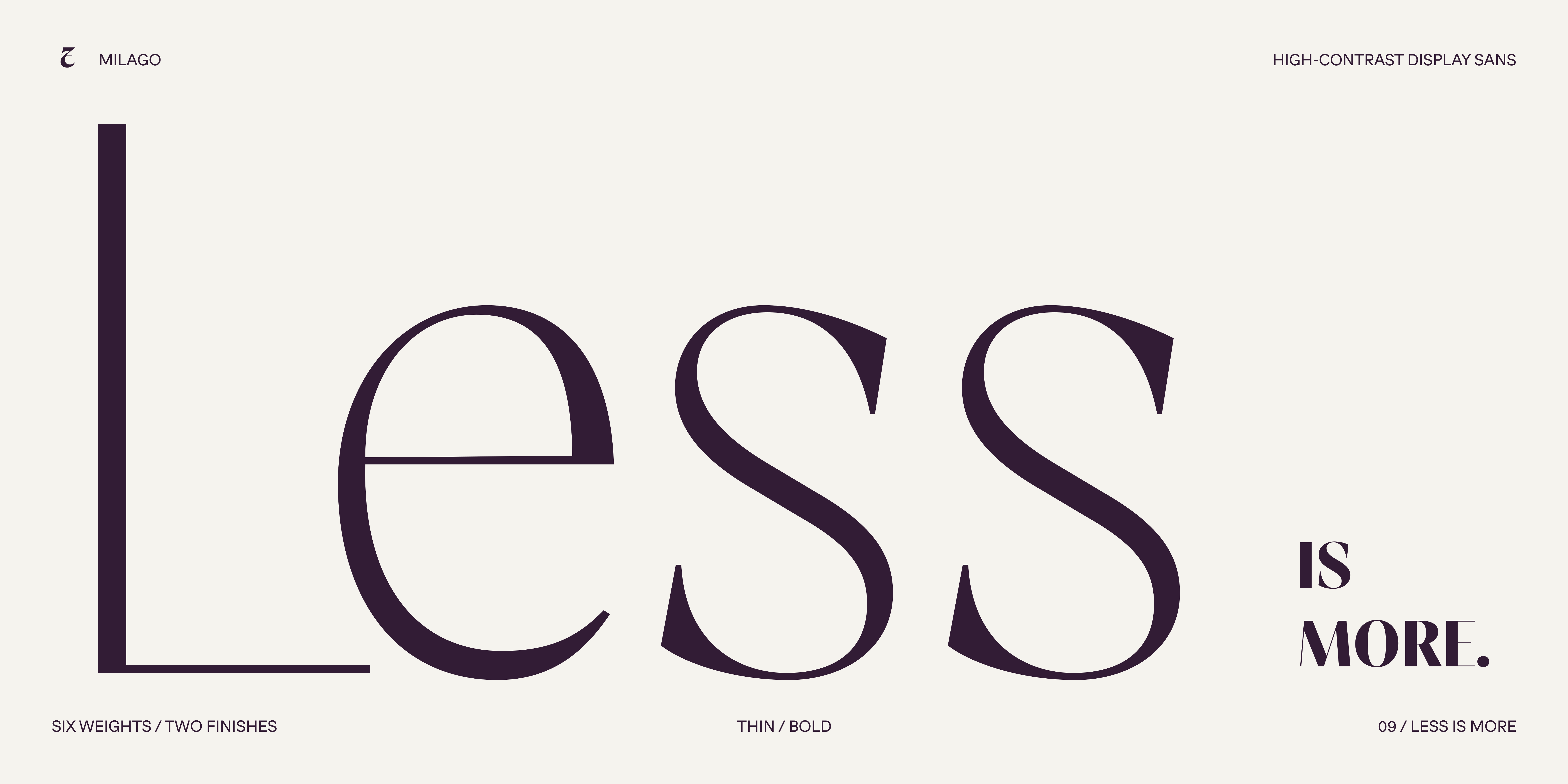
Striking a balance between structural discipline and fluid rhythm, Milago introduces high-contrast stroke variance to the modern sans-serif. Designed to command attention at large display sizes, its polished cadence relies on an abrupt, dramatic shift between stems and hairlines. From a delicate Thin to an authoritative Black, Milago’s six core weights are paired with a sub-family of rounded companions. These companions offer an organic warmth by smoothing the outer contours and counters without compromising the typeface's foundational DNA.

Technical

Metrics

Reading font data…

Axes

Variable axes: Weight (wght) 100–900, Roundness (ROND) 0–100.

Features

OpenType layout data is included in the font files.

Credits

Designed and released by Oztype in 2021.

Information

2021

Family

Milago

Classification
Display
Styles
12 styles
Format
Variable + static OpenType
Scripts
Latin
Designer
Oussama Horchani
Milago PDF specimen cover
Download PDF specimen
Get trial fonts

About

Striking a balance between structural discipline and fluid rhythm, Milago introduces high-contrast stroke variance to the modern sans-serif. Designed to command attention at large display sizes, its polished cadence relies on an abrupt, dramatic shift between stems and hairlines. From a delicate Thin to an authoritative Black, Milago’s six core weights are paired with a sub-family of rounded companions. These companions offer an organic warmth by smoothing the outer contours and counters without compromising the typeface's foundational DNA.

Specifications

Glyphs
514

Variable axes

Weightwght100 — 900
RoundnessROND0 — 100

OpenType features

Case-Sensitive Formscase
Glyph Composition / Decompositionccmp
Discretionary Ligaturesdlig
Fractionsfrac
Historical Formshist
Kerningkern
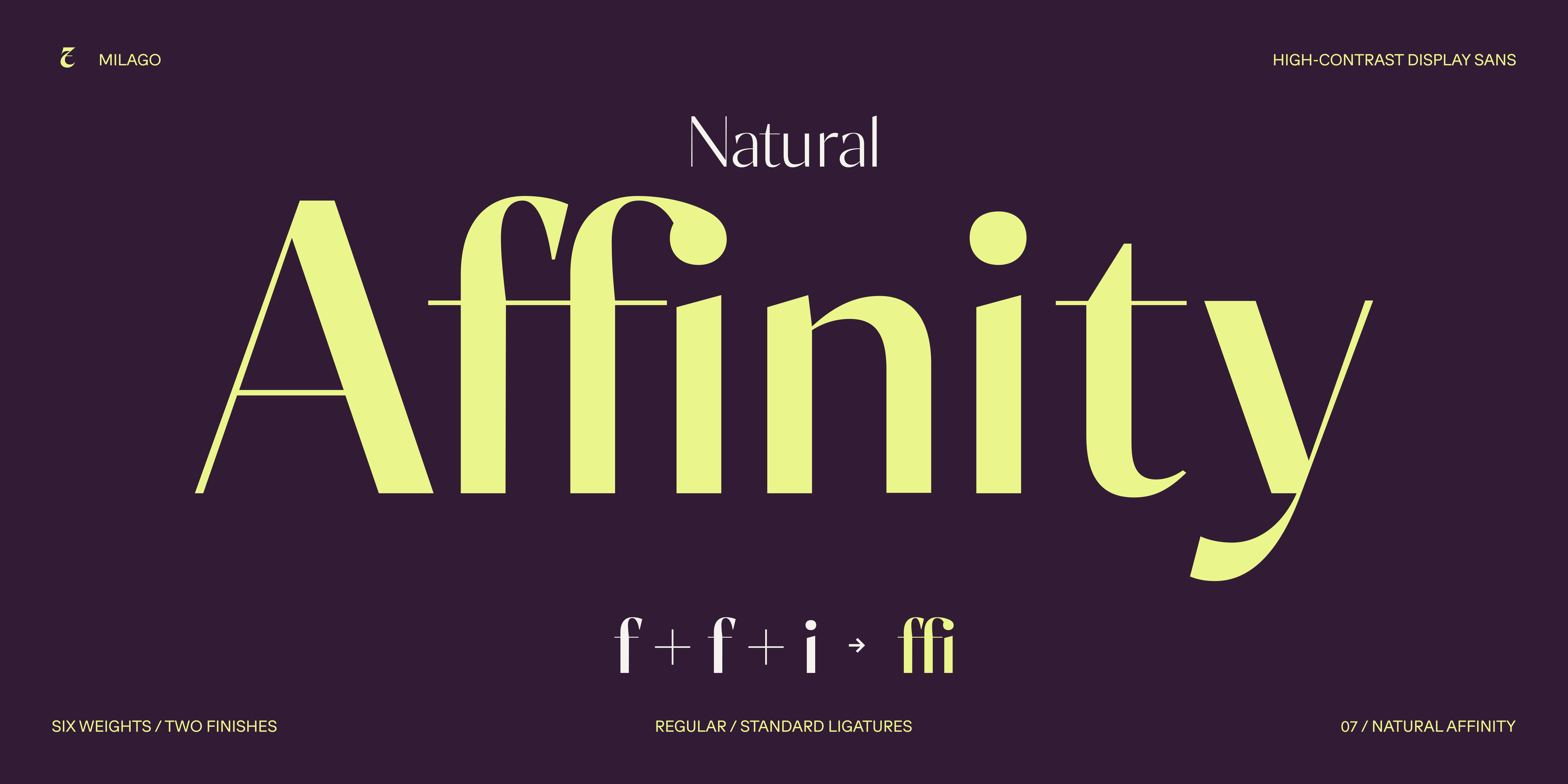
Standard Ligaturesliga
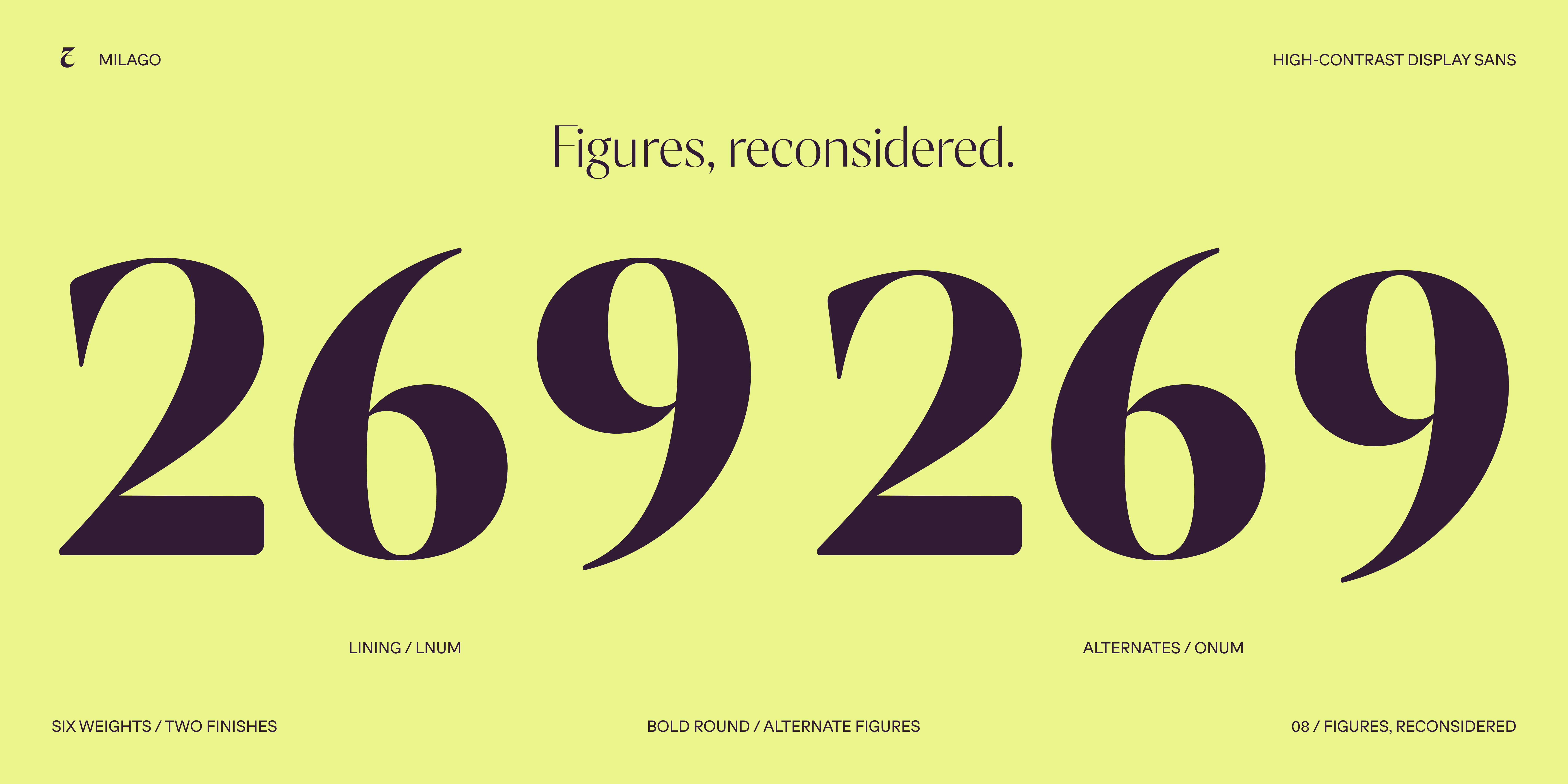
Lining Figureslnum
Localized Formslocl
Oldstyle Figuresonum
Ordinalsordn
Stylistic Alternatessalt
Scientific Inferiorssinf
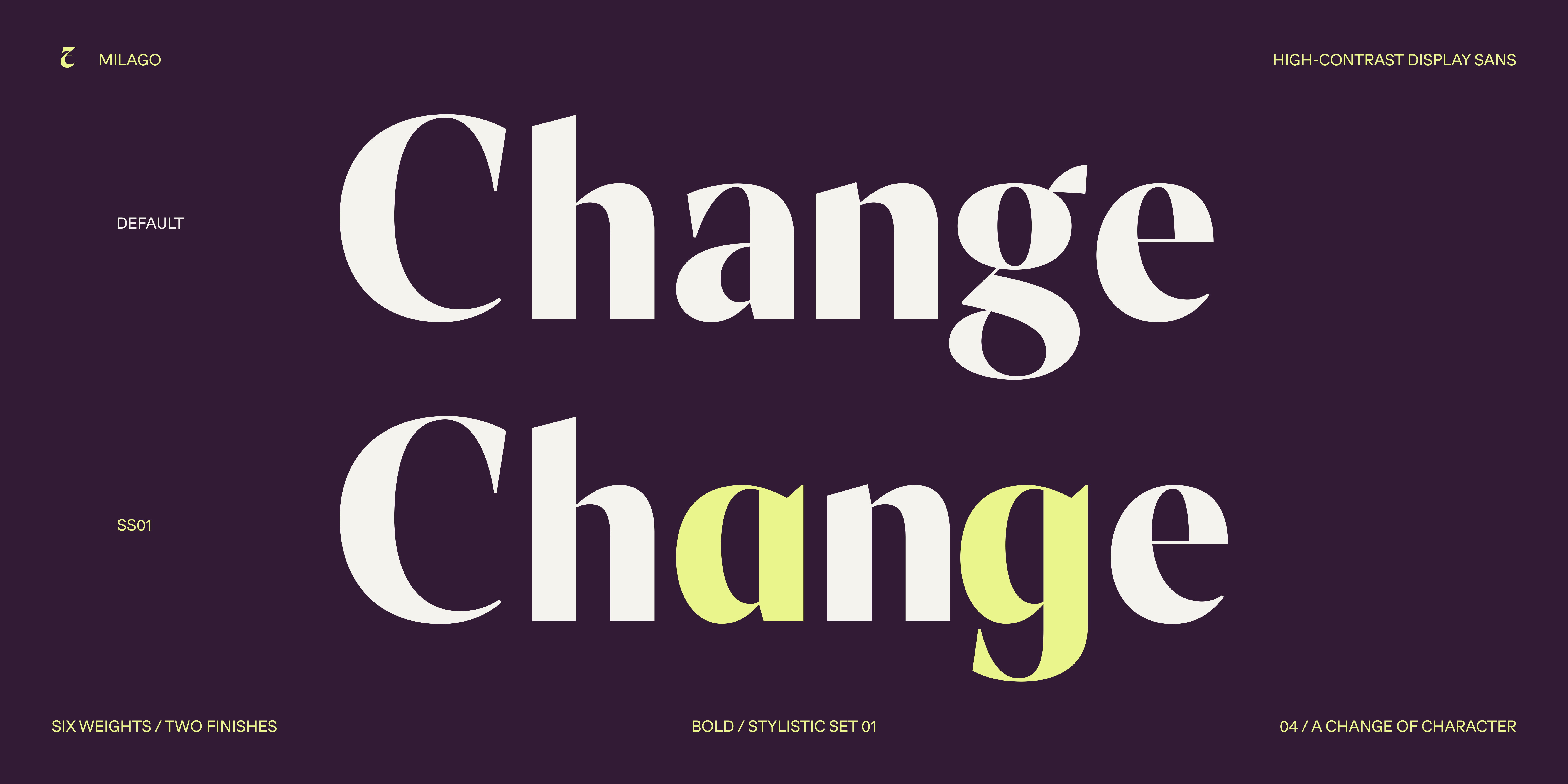
Single-storey a,g / Vertical axis oss01
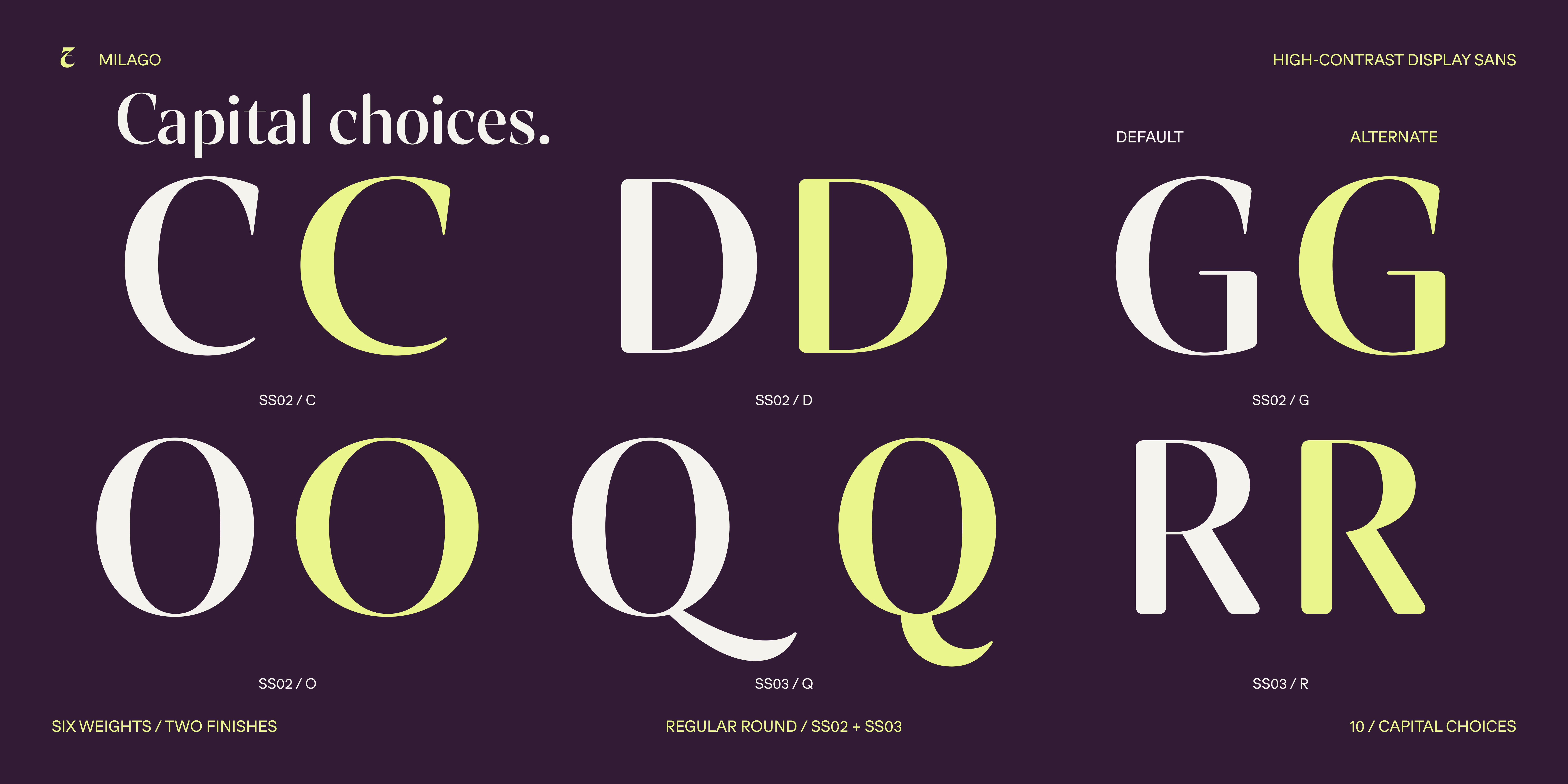
Wide circular C, D, G, and Oss02
Short-tail Q & Disconnected Rss03
Structural № and Directional arrowsss04
Feathered Arrowsss05
Asterisk 01ss06
Asterisk 02ss07
Asterisk 03ss08
Asterisk 04ss09
Display Quotesss10
Display Exclamationss11
Alternate Caronss12
Subscriptsubs
Superscriptsups

Supported Languages

130 supported

Latin

  • Afar
  • Afrikaans
  • Aragonese
  • Asu
  • Bemba
  • Bena
  • Bosnian
  • Catalan
  • Cebuano
  • Chiga
  • Corsican
  • Czech
  • Welsh
  • Danish
  • Taita
  • German
  • Lower Sorbian
  • Jola-Fonyi
  • Embu
  • English