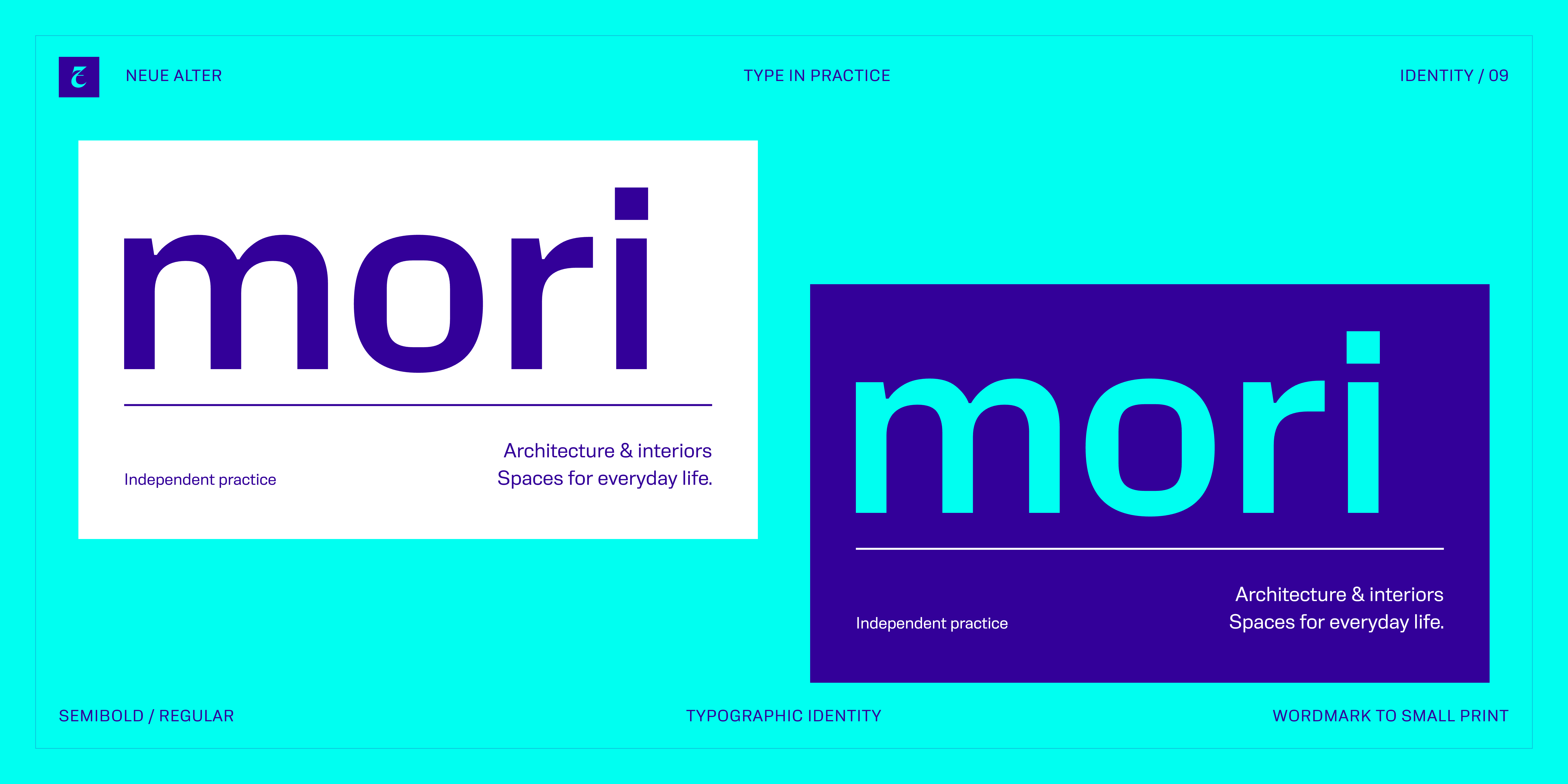
Neue Alter

01

Type Tester

Editable
Size262px
Weightwght400
Italicital0
Light
Size172px
Leading0.92
Tracking-0.5
Align
Flow
Banneton
Weightwght300
Italicital0
Light Italic
Size266px
Leading0.92
Tracking-0.5
Align
Flow
Levain
Weightwght300
Italicital1
Regular
Size194px
Leading0.92
Tracking-0.8
Align
Flow
Focaccia
Weightwght400
Italicital0
Italic
Size214px
Leading0.92
Tracking-0.5
Align
Flow
Brioche
Weightwght400
Italicital1
Semibold
Size228px
Leading0.92
Tracking-1
Align
Flow
Poolish
Weightwght600
Italicital0
Semibold Italic
Size248px
Leading0.92
Tracking-0.8
Align
Flow
Grigne
Weightwght600
Italicital1
Bold
Size270px
Leading0.92
Tracking-1.2
Align
Flow
Miche
Weightwght700
Italicital0
Bold Italic
Size236px
Leading0.92
Tracking-1
Align
Flow
Bâtard
Weightwght700
Italicital1

The starter jar

Light · 18px · 3 columns
Size18px
Leading1.42
Tracking0
Align
Flow
On a cool morning, the starter is taken from the refrigerator before anything else is mixed. A spoonful goes into a clean jar with fresh flour and water, then the sides are scraped down so the rise can be read clearly. At first the paste sits low and dense. Over the next few hours small bubbles gather along the glass, the surface rounds, and the smell shifts from raw grain toward fruit and mild acidity. The exact pace depends on the room. A warm shelf shortens the wait; a colder bench stretches it into the afternoon. Bakers learn to watch the mixture rather than the clock. When the starter has expanded and still holds a little tension at the top, part of it is folded into the day's dough. The remainder is refreshed again or returned to the cold. This simple cycle can continue for years, but it is never completely automatic. Different flours absorb water differently, summer and winter alter the rhythm, and a jar left untouched for too long needs several careful feeds before it becomes lively again. What matters is consistency: clean tools, measured additions, enough time, and attention to the signs that the culture is ready.
Weightwght300
Italicital0

Steam and crust

Light · 26px · 2 columns
Size26px
Leading1.35
Tracking0
Align
Flow
When a loaf enters a hot oven, the first minutes determine much of its final shape. Moisture inside the dough turns to steam, gases expand, and the scored surface opens along the weakest line. Bakers often add steam to the oven as well, delaying the formation of a hard crust so the loaf can continue to rise. The surface stays supple briefly, then begins to dry and colour. Pale gold moves toward amber, thin edges darken first, and the smell of toasted grain fills the room. Near the end of baking, the crust is firm enough to sound hollow when tapped, yet the interior is still setting. Cutting too early releases heat and moisture that the crumb needs to redistribute. The loaf is therefore left on a rack, exposed to air on every side, until its warmth falls and the crust takes on its final texture.
Weightwght300
Italicital0

Stone-ground flour

Regular · 18px · 3 columns
Size18px
Leading1.40
Tracking0
Align
Flow
Flour can look uniform in a bag while carrying a great deal of information about how it was milled. Stone mills crush the grain between rotating surfaces, breaking the kernel gradually rather than separating it in a single pass. The resulting flour may retain more of the bran and germ, giving it a warmer colour, a stronger aroma, and a thirstier response to water. A baker testing a new batch starts with familiar proportions but keeps some water back. After a short rest, the dough reveals whether it needs more. Fine flour can feel smooth almost immediately; a coarser meal takes longer to soften as the outer particles absorb moisture. Protein content matters, but so do extraction rate, grain variety, storage, and the freshness of the milling. For that reason, recipes written only as fixed numbers are never the whole story. The same formula can behave differently from one sack to the next. Experienced bakers make small corrections without changing the character of the bread: a little more water, a longer rest, a gentler fold, or a cooler fermentation. The goal is not to force every flour into identical behaviour. It is to understand what the flour is offering and adjust the process so its flavour and structure can develop together.
Weightwght400
Italicital0

Cooling time

Regular · 26px · 2 columns
Size26px
Leading1.34
Tracking0
Align
Flow
A finished loaf continues changing after it leaves the oven. The crust contracts as it cools, sometimes producing a faint crackle, while moisture moves outward from the hotter centre. Inside, the crumb is still soft enough to compress easily, and the starches need time to settle into a stable structure. This is why a loaf cut straight from the oven can seem gummy even when it is fully baked. Resting is part of the recipe. Small rolls may be ready quickly, but a large rye loaf can benefit from several hours, or even an overnight wait, before slicing. The rack keeps air moving beneath the base and prevents trapped steam from softening the crust too soon. Once the loaf reaches room temperature, its aroma becomes clearer and the knife passes through without dragging the crumb. The delay is simple, but it often separates a good bake from a rushed one.
Weightwght400
Italicital0

Batch ratios

Recipe fractions
Size64px
Leading1.08
Tracking-0.3
Align
Flow
1/2 rye · 1/4 spelt · 3/4 water
Weightwght600
Italicital0

Ligature pairs

Flour ligatures
Size46px
Leading1.08
Tracking-0.3
Align
Flow
muffin filling · fluffy flatbread · fine flour
Weightwght400
Italicital0

Oven card

Case-sensitive forms
Size46px
Leading1.08
Tracking-0.3
Align
Flow
MIX—REST—FOLD (OVEN @ 230°C)
Weightwght700
Italicital0

Ordinal notes

Português · Ordinals
Size54px
Leading1.08
Tracking-0.3
Align
Flow
1a fornada · 2o descanso · 3a dobra
Weightwght400
Italicital0
02

Glyph Map

Loading Light…
AU+0041
100%
Glyph name
—
Unicode
U+0041
Decimal
65
Advance
—
Sidebearings
—
01/10

Specimens

2:1
Neue Alter: Everyday language
04

Information

2022

Family

Neue Alter

Sans
8 styles
Latin, Latin Extended, Symbols
Released 2022

Variable and static OpenType formats.

Neue Alter

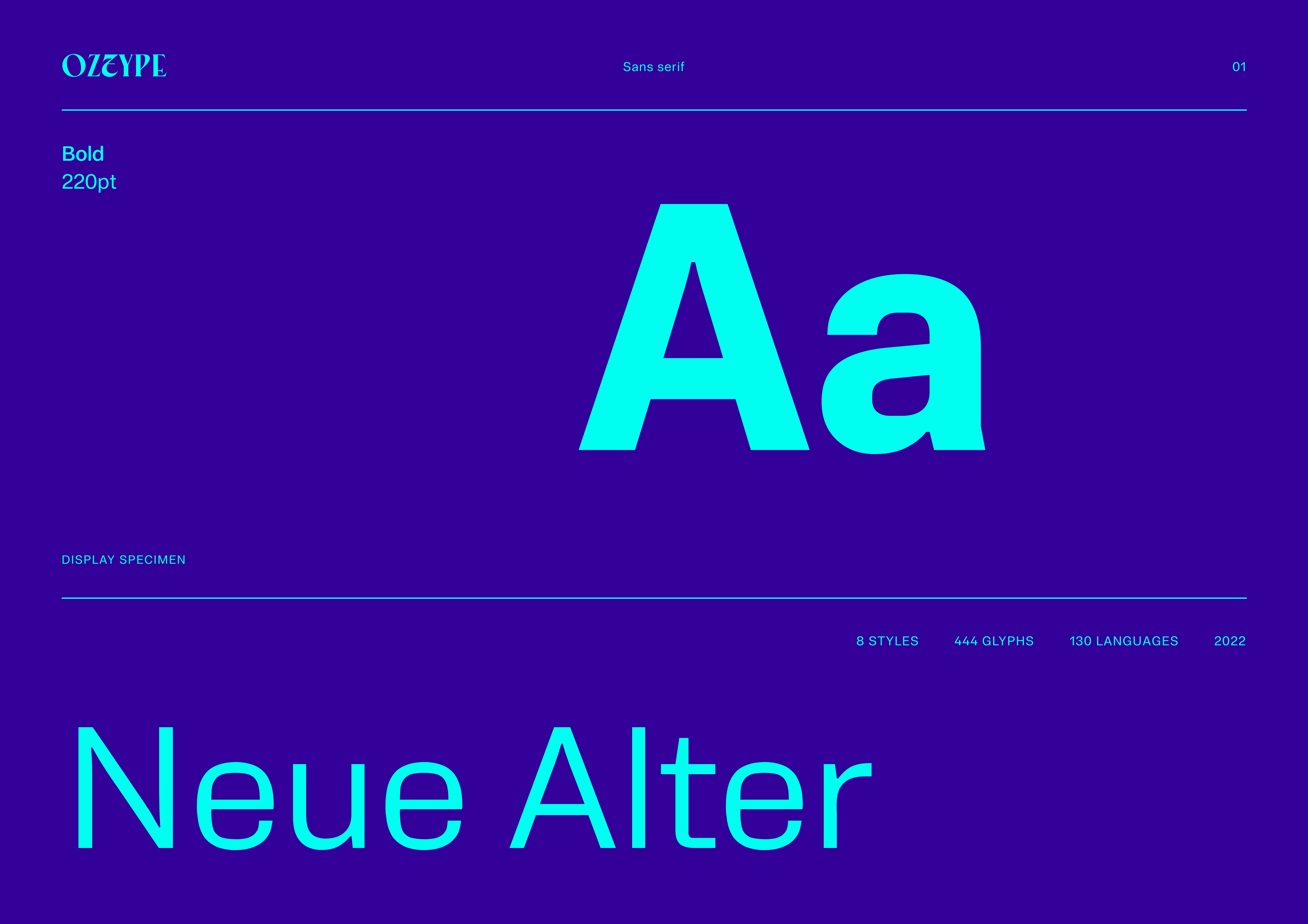
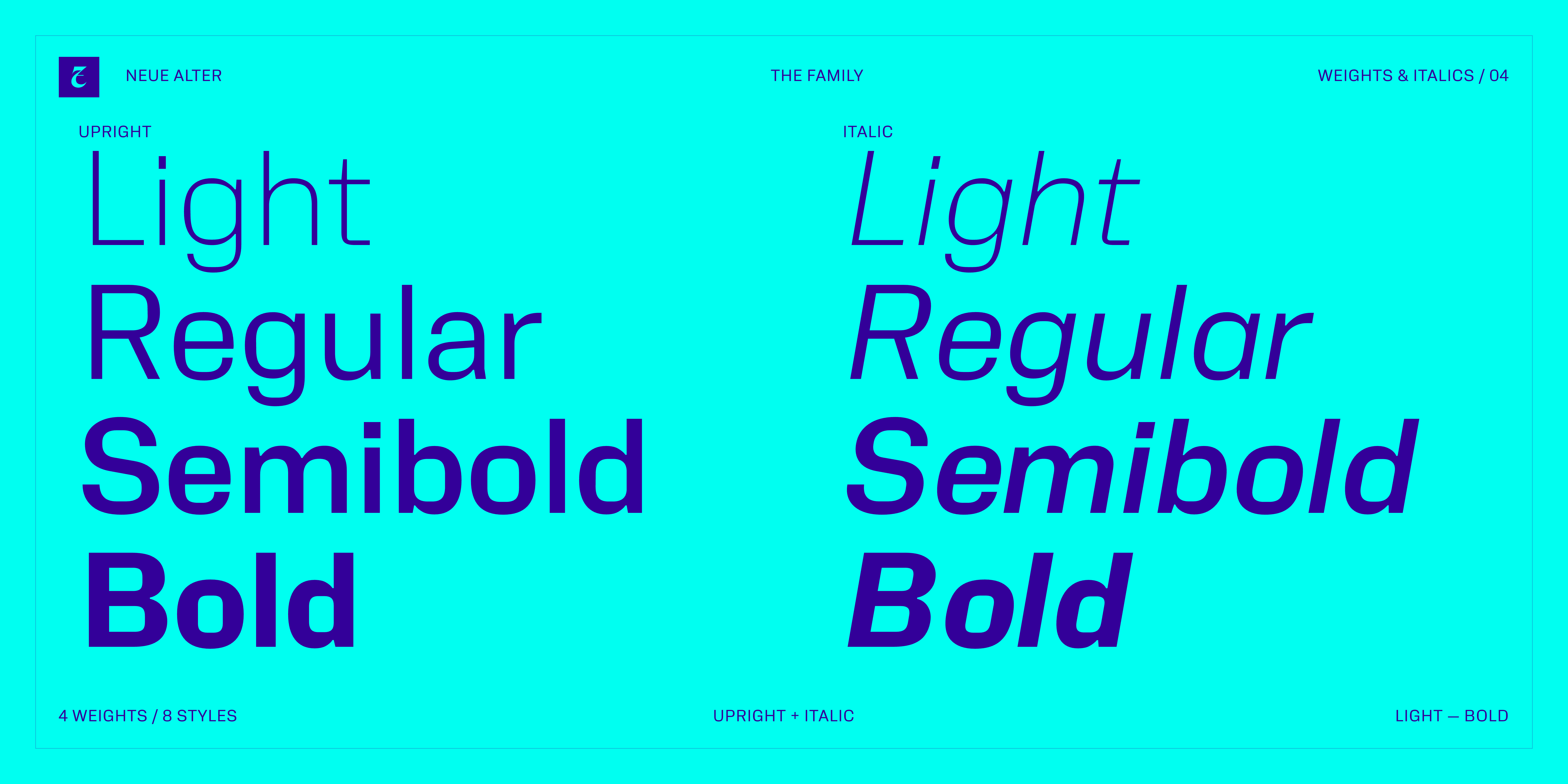
Neue Alter is a concise, high-efficiency type system balancing functional order with a tactile, expressive texture across reading and headline sizes. Spanning four core weights (Light to Bold) with matching italics, its direct proportions offer maximum clarity in interface navigation, captions, and editorial layouts. By introducing subtle structural irregularities in its extreme weights, the family establishes visual hierarchy through character and presence, rather than sheer mass alone.

Technical

Metrics

Reading font data…

Axes

Variable axes: Weight (wght) 300–700, Italic (ital) 0–1.

Features

OpenType layout data is included in the font files.

Credits

Designed and released by Oztype in 2022.

Information

2022

Family

Neue Alter

Classification
Sans
Styles
8 styles
Format
Variable + static OpenType
Scripts
Latin, Latin Extended, Symbols
Designer
Oussama Horchani
Neue Alter PDF specimen cover
Download PDF specimen
Get trial fonts

About

Neue Alter is a concise, high-efficiency type system balancing functional order with a tactile, expressive texture across reading and headline sizes. Spanning four core weights (Light to Bold) with matching italics, its direct proportions offer maximum clarity in interface navigation, captions, and editorial layouts. By introducing subtle structural irregularities in its extreme weights, the family establishes visual hierarchy through character and presence, rather than sheer mass alone.

Specifications

Glyphs
444

Variable axes

Weightwght300 — 700
Italicital0 — 1

OpenType features

Access All Alternatesaalt
Case-Sensitive Formscase
Glyph Composition / Decompositionccmp
Discretionary Ligaturesdlig
Fractionsfrac
Historical Formshist
Kerningkern
Standard Ligaturesliga
Localized Formslocl
Ordinalsordn
Stylistic Alternatessalt
Scientific Inferiorssinf
Subscriptsubs
Superscriptsups

Supported Languages

130 supported

Latin · Latin Extended · Symbols
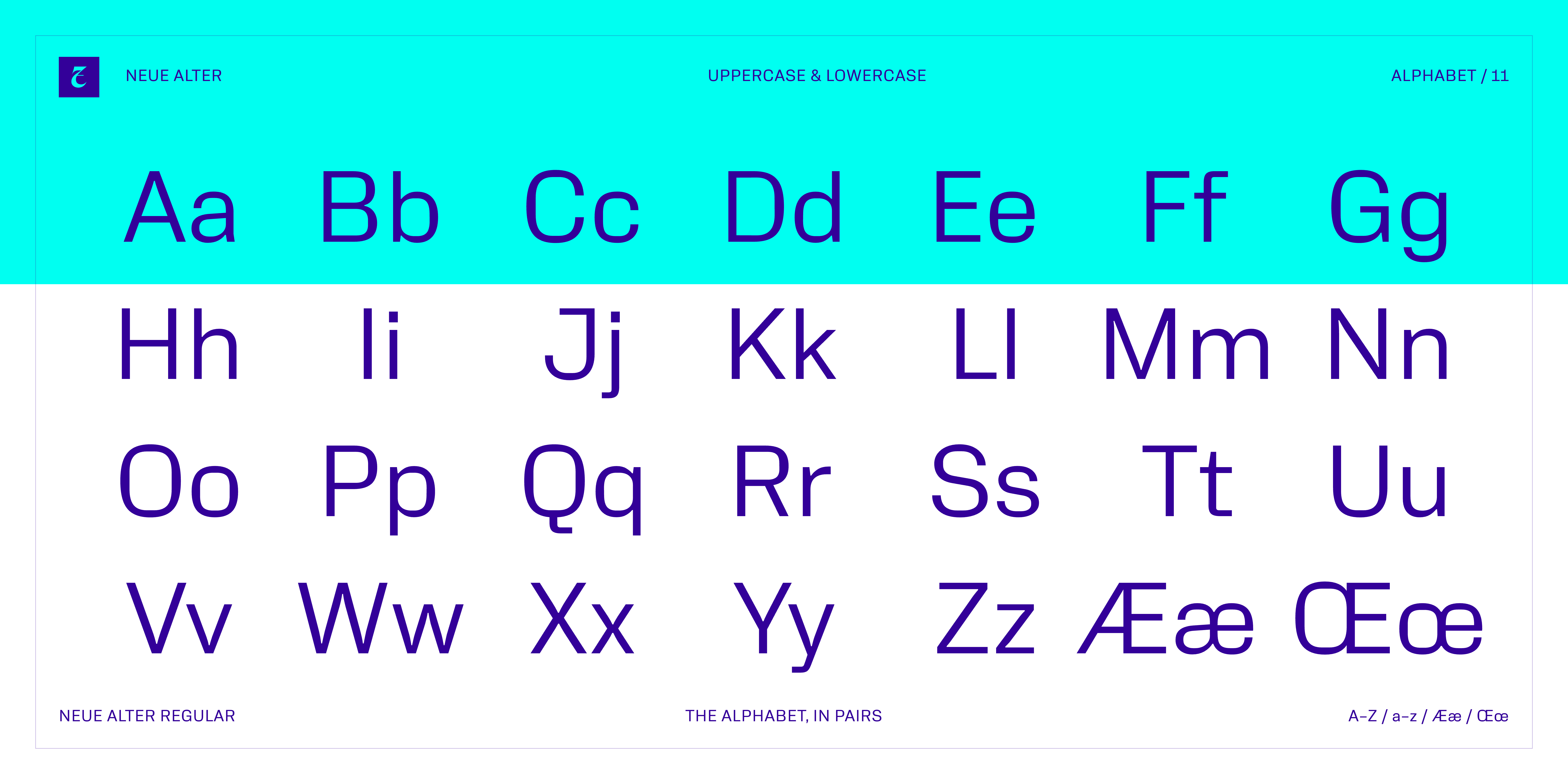
  • Afar
  • Afrikaans
  • Aragonese
  • Asu
  • Bemba
  • Bena
  • Bosnian
  • Catalan
  • Cebuano
  • Chiga
  • Corsican
  • Czech
  • Welsh
  • Danish
  • Taita
  • German
  • Lower Sorbian
  • Jola-Fonyi
  • Embu
  • English