OT Magnet

01

Type Tester

Editable
Size280px
Weightwght329
Italicital0
Thin
Size278px
Leading0.92
Tracking0
Align
Flow
Meridian
Weightwght100
Italicital0
Thin Italic
Size359px
Leading0.92
Tracking0
Align
Flow
Aurora
Weightwght100
Italicital100
Light
Size244px
Leading0.92
Tracking0
Align
Flow
Compass
Weightwght214
Italicital0
Light Italic
Size263px
Leading0.92
Tracking0
Align
Flow
Lodestar
Weightwght214
Italicital100
Regular
Size242px
Leading0.92
Tracking0
Align
Flow
Fieldwork
Weightwght329
Italicital0
Regular Italic
Size280px
Leading0.92
Tracking0
Align
Flow
Solstice
Weightwght329
Italicital100
Book
Size195px
Leading0.92
Tracking0
Align
Flow
Switchback
Weightwght443
Italicital0
Book Italic
Size236px
Leading0.92
Tracking0
Align
Flow
Reykjavík
Weightwght443
Italicital100
Medium
Size294px
Leading0.92
Tracking0
Align
Flow
Current
Weightwght557
Italicital0
Medium Italic
Size239px
Leading0.92
Tracking0
Align
Flow
Sundown
Weightwght557
Italicital100
Bold
Size208px
Leading0.92
Tracking0
Align
Flow
Wayfinder
Weightwght671
Italicital0
Bold Italic
Size225px
Leading0.92
Tracking0
Align
Flow
Headland
Weightwght671
Italicital100
Heavy
Size226px
Leading0.92
Tracking0
Align
Flow
Overland
Weightwght786
Italicital0
Heavy Italic
Size202px
Leading0.92
Tracking0
Align
Flow
Longwave
Weightwght786
Italicital100
Black
Size193px
Leading0.92
Tracking0
Align
Flow
Nightshift
Weightwght900
Italicital0
Black Italic
Size260px
Leading0.92
Tracking0
Align
Flow
Gravity
Weightwght900
Italicital100
Light · 18px · 3 columns
Size18px
Leading1.45
Tracking0
Align
Flow
At the edge of the industrial estate, a small fabrication studio begins work before the neighbouring units open their doors. The first hour is quiet enough to hear the extraction fans starting one by one and the dry click of clamps being set along the benches. Sheets of aluminium lean against one wall beside rolls of paper, acrylic panels and lengths of timber marked with pencil notes from the previous afternoon. Nothing is arranged for display; every surface is organised around the next operation. One technician checks a cutting list against a stack of labelled parts while another measures the first panel twice before sending it through the saw. Offcuts are sorted by size rather than thrown away. Narrow strips become spacers, packing pieces or test samples for paint. By midmorning the studio is fully active. A drill press runs at the back, a sander moves steadily along an edge, and someone in the finishing room mixes a small batch of grey from three larger tins. Measurements pass from one bench to another on scraps of masking tape. If a hole shifts by two millimetres, the next component changes with it. The work depends less on speed than on keeping every decision connected. Around noon, finished pieces begin to gather on padded racks. Each one is checked for scratches, sharp edges and alignment before being wrapped. The larger assemblies are built on the floor, where there is enough room to step back and compare their proportions. A frame that looked balanced on a drawing can feel too heavy once it stands upright, so brackets are moved, gaps are widened and the sequence is tested again. In the afternoon, the pace becomes more deliberate. Labels are printed, fixings are counted into bags and every package receives a number that matches the installation plan. The final hour is reserved for cleaning machines and returning tools to the same places they occupied that morning. Dust settles quickly if it is ignored, and a missing bit or blade wastes more time the next day than putting it away now. Before the lights are switched off, the completed work is lined against the loading door in the order it will be needed. The studio looks almost empty again, but the arrangement tells the story of the day: material cut, adjusted, finished, checked and made ready to leave.
Weightwght214
Italicital0
Light · 26px · 2 columns
Size26px
Leading1.40
Tracking0
Align
Flow
After rain, the greenhouse holds light differently. Water remains on the roof panels in shallow beads, softening the view of the sky and turning every metal frame into a dark line. The central path is still damp when the doors open, and the air carries the mixed smell of soil, citrus leaves and warm stone. Staff move through the beds with small carts, checking labels, trimming damaged stems and lifting pots that have become too heavy with water. In the propagation room, rows of young plants sit beneath simple lamps, each tray dated by hand. Nothing grows at the same rate. Some cuttings are ready to move after a week; others remain almost unchanged for a month. By midday the roof vents are open and the temperature begins to fall. Visitors slow down near the taller palms, then gather around a bench of herbs where every leaf seems familiar until its name is read. Late in the afternoon the glass clears, shadows sharpen across the path and the greenhouse becomes quieter. Hoses are coiled, tools are rinsed and the last cart is returned to the workroom. The plants remain where they are, but the room feels reset for another day.
Weightwght214
Italicital0
Book · 18px · 3 columns
Size18px
Leading1.45
Tracking0
Align
Flow
At the edge of the industrial estate, a small fabrication studio begins work before the neighbouring units open their doors. The first hour is quiet enough to hear the extraction fans starting one by one and the dry click of clamps being set along the benches. Sheets of aluminium lean against one wall beside rolls of paper, acrylic panels and lengths of timber marked with pencil notes from the previous afternoon. Nothing is arranged for display; every surface is organised around the next operation. One technician checks a cutting list against a stack of labelled parts while another measures the first panel twice before sending it through the saw. Offcuts are sorted by size rather than thrown away. Narrow strips become spacers, packing pieces or test samples for paint. By midmorning the studio is fully active. A drill press runs at the back, a sander moves steadily along an edge, and someone in the finishing room mixes a small batch of grey from three larger tins. Measurements pass from one bench to another on scraps of masking tape. If a hole shifts by two millimetres, the next component changes with it. The work depends less on speed than on keeping every decision connected. Around noon, finished pieces begin to gather on padded racks. Each one is checked for scratches, sharp edges and alignment before being wrapped. The larger assemblies are built on the floor, where there is enough room to step back and compare their proportions. A frame that looked balanced on a drawing can feel too heavy once it stands upright, so brackets are moved, gaps are widened and the sequence is tested again. In the afternoon, the pace becomes more deliberate. Labels are printed, fixings are counted into bags and every package receives a number that matches the installation plan. The final hour is reserved for cleaning machines and returning tools to the same places they occupied that morning. Dust settles quickly if it is ignored, and a missing bit or blade wastes more time the next day than putting it away now. Before the lights are switched off, the completed work is lined against the loading door in the order it will be needed. The studio looks almost empty again, but the arrangement tells the story of the day: material cut, adjusted, finished, checked and made ready to leave.
Weightwght443
Italicital0
Book · 26px · 2 columns
Size26px
Leading1.40
Tracking0
Align
Flow
After rain, the greenhouse holds light differently. Water remains on the roof panels in shallow beads, softening the view of the sky and turning every metal frame into a dark line. The central path is still damp when the doors open, and the air carries the mixed smell of soil, citrus leaves and warm stone. Staff move through the beds with small carts, checking labels, trimming damaged stems and lifting pots that have become too heavy with water. In the propagation room, rows of young plants sit beneath simple lamps, each tray dated by hand. Nothing grows at the same rate. Some cuttings are ready to move after a week; others remain almost unchanged for a month. By midday the roof vents are open and the temperature begins to fall. Visitors slow down near the taller palms, then gather around a bench of herbs where every leaf seems familiar until its name is read. Late in the afternoon the glass clears, shadows sharpen across the path and the greenhouse becomes quieter. Hoses are coiled, tools are rinsed and the last cart is returned to the workroom. The plants remain where they are, but the room feels reset for another day.
Weightwght443
Italicital0
Regular · 18px · 3 columns
Size18px
Leading1.45
Tracking0
Align
Flow
At the edge of the industrial estate, a small fabrication studio begins work before the neighbouring units open their doors. The first hour is quiet enough to hear the extraction fans starting one by one and the dry click of clamps being set along the benches. Sheets of aluminium lean against one wall beside rolls of paper, acrylic panels and lengths of timber marked with pencil notes from the previous afternoon. Nothing is arranged for display; every surface is organised around the next operation. One technician checks a cutting list against a stack of labelled parts while another measures the first panel twice before sending it through the saw. Offcuts are sorted by size rather than thrown away. Narrow strips become spacers, packing pieces or test samples for paint. By midmorning the studio is fully active. A drill press runs at the back, a sander moves steadily along an edge, and someone in the finishing room mixes a small batch of grey from three larger tins. Measurements pass from one bench to another on scraps of masking tape. If a hole shifts by two millimetres, the next component changes with it. The work depends less on speed than on keeping every decision connected. Around noon, finished pieces begin to gather on padded racks. Each one is checked for scratches, sharp edges and alignment before being wrapped. The larger assemblies are built on the floor, where there is enough room to step back and compare their proportions. A frame that looked balanced on a drawing can feel too heavy once it stands upright, so brackets are moved, gaps are widened and the sequence is tested again. In the afternoon, the pace becomes more deliberate. Labels are printed, fixings are counted into bags and every package receives a number that matches the installation plan. The final hour is reserved for cleaning machines and returning tools to the same places they occupied that morning. Dust settles quickly if it is ignored, and a missing bit or blade wastes more time the next day than putting it away now. Before the lights are switched off, the completed work is lined against the loading door in the order it will be needed. The studio looks almost empty again, but the arrangement tells the story of the day: material cut, adjusted, finished, checked and made ready to leave.
Weightwght329
Italicital0
Regular · 26px · 2 columns
Size26px
Leading1.40
Tracking0
Align
Flow
After rain, the greenhouse holds light differently. Water remains on the roof panels in shallow beads, softening the view of the sky and turning every metal frame into a dark line. The central path is still damp when the doors open, and the air carries the mixed smell of soil, citrus leaves and warm stone. Staff move through the beds with small carts, checking labels, trimming damaged stems and lifting pots that have become too heavy with water. In the propagation room, rows of young plants sit beneath simple lamps, each tray dated by hand. Nothing grows at the same rate. Some cuttings are ready to move after a week; others remain almost unchanged for a month. By midday the roof vents are open and the temperature begins to fall. Visitors slow down near the taller palms, then gather around a bench of herbs where every leaf seems familiar until its name is read. Late in the afternoon the glass clears, shadows sharpen across the path and the greenhouse becomes quieter. Hoses are coiled, tools are rinsed and the last cart is returned to the workroom. The plants remain where they are, but the room feels reset for another day.
Weightwght329
Italicital0
Medium · 18px · 3 columns
Size18px
Leading1.45
Tracking0
Align
Flow
At the edge of the industrial estate, a small fabrication studio begins work before the neighbouring units open their doors. The first hour is quiet enough to hear the extraction fans starting one by one and the dry click of clamps being set along the benches. Sheets of aluminium lean against one wall beside rolls of paper, acrylic panels and lengths of timber marked with pencil notes from the previous afternoon. Nothing is arranged for display; every surface is organised around the next operation. One technician checks a cutting list against a stack of labelled parts while another measures the first panel twice before sending it through the saw. Offcuts are sorted by size rather than thrown away. Narrow strips become spacers, packing pieces or test samples for paint. By midmorning the studio is fully active. A drill press runs at the back, a sander moves steadily along an edge, and someone in the finishing room mixes a small batch of grey from three larger tins. Measurements pass from one bench to another on scraps of masking tape. If a hole shifts by two millimetres, the next component changes with it. The work depends less on speed than on keeping every decision connected. Around noon, finished pieces begin to gather on padded racks. Each one is checked for scratches, sharp edges and alignment before being wrapped. The larger assemblies are built on the floor, where there is enough room to step back and compare their proportions. A frame that looked balanced on a drawing can feel too heavy once it stands upright, so brackets are moved, gaps are widened and the sequence is tested again. In the afternoon, the pace becomes more deliberate. Labels are printed, fixings are counted into bags and every package receives a number that matches the installation plan. The final hour is reserved for cleaning machines and returning tools to the same places they occupied that morning. Dust settles quickly if it is ignored, and a missing bit or blade wastes more time the next day than putting it away now. Before the lights are switched off, the completed work is lined against the loading door in the order it will be needed. The studio looks almost empty again, but the arrangement tells the story of the day: material cut, adjusted, finished, checked and made ready to leave.
Weightwght557
Italicital0
Medium · 26px · 2 columns
Size26px
Leading1.40
Tracking0
Align
Flow
After rain, the greenhouse holds light differently. Water remains on the roof panels in shallow beads, softening the view of the sky and turning every metal frame into a dark line. The central path is still damp when the doors open, and the air carries the mixed smell of soil, citrus leaves and warm stone. Staff move through the beds with small carts, checking labels, trimming damaged stems and lifting pots that have become too heavy with water. In the propagation room, rows of young plants sit beneath simple lamps, each tray dated by hand. Nothing grows at the same rate. Some cuttings are ready to move after a week; others remain almost unchanged for a month. By midday the roof vents are open and the temperature begins to fall. Visitors slow down near the taller palms, then gather around a bench of herbs where every leaf seems familiar until its name is read. Late in the afternoon the glass clears, shadows sharpen across the path and the greenhouse becomes quieter. Hoses are coiled, tools are rinsed and the last cart is returned to the workroom. The plants remain where they are, but the room feels reset for another day.
Weightwght557
Italicital0
Bold · 18px · 3 columns
Size18px
Leading1.45
Tracking0
Align
Flow
At the edge of the industrial estate, a small fabrication studio begins work before the neighbouring units open their doors. The first hour is quiet enough to hear the extraction fans starting one by one and the dry click of clamps being set along the benches. Sheets of aluminium lean against one wall beside rolls of paper, acrylic panels and lengths of timber marked with pencil notes from the previous afternoon. Nothing is arranged for display; every surface is organised around the next operation. One technician checks a cutting list against a stack of labelled parts while another measures the first panel twice before sending it through the saw. Offcuts are sorted by size rather than thrown away. Narrow strips become spacers, packing pieces or test samples for paint. By midmorning the studio is fully active. A drill press runs at the back, a sander moves steadily along an edge, and someone in the finishing room mixes a small batch of grey from three larger tins. Measurements pass from one bench to another on scraps of masking tape. If a hole shifts by two millimetres, the next component changes with it. The work depends less on speed than on keeping every decision connected. Around noon, finished pieces begin to gather on padded racks. Each one is checked for scratches, sharp edges and alignment before being wrapped. The larger assemblies are built on the floor, where there is enough room to step back and compare their proportions. A frame that looked balanced on a drawing can feel too heavy once it stands upright, so brackets are moved, gaps are widened and the sequence is tested again. In the afternoon, the pace becomes more deliberate. Labels are printed, fixings are counted into bags and every package receives a number that matches the installation plan. The final hour is reserved for cleaning machines and returning tools to the same places they occupied that morning. Dust settles quickly if it is ignored, and a missing bit or blade wastes more time the next day than putting it away now. Before the lights are switched off, the completed work is lined against the loading door in the order it will be needed. The studio looks almost empty again, but the arrangement tells the story of the day: material cut, adjusted, finished, checked and made ready to leave.
Weightwght671
Italicital0
Bold · 26px · 2 columns
Size26px
Leading1.40
Tracking0
Align
Flow
After rain, the greenhouse holds light differently. Water remains on the roof panels in shallow beads, softening the view of the sky and turning every metal frame into a dark line. The central path is still damp when the doors open, and the air carries the mixed smell of soil, citrus leaves and warm stone. Staff move through the beds with small carts, checking labels, trimming damaged stems and lifting pots that have become too heavy with water. In the propagation room, rows of young plants sit beneath simple lamps, each tray dated by hand. Nothing grows at the same rate. Some cuttings are ready to move after a week; others remain almost unchanged for a month. By midday the roof vents are open and the temperature begins to fall. Visitors slow down near the taller palms, then gather around a bench of herbs where every leaf seems familiar until its name is read. Late in the afternoon the glass clears, shadows sharpen across the path and the greenhouse becomes quieter. Hoses are coiled, tools are rinsed and the last cart is returned to the workroom. The plants remain where they are, but the room feels reset for another day.
Weightwght671
Italicital0

Agate study

ss01 + ss02
Size88px
Leading1.12
Tracking0
Align
Flow
A glassmaker arranges agate fragments across a gallery table.
Weightwght671
Italicital0

Edition marks

ss03
Size92px
Leading1.12
Tracking0
Align
Flow
Edition © 2026 · Registered ®
Weightwght557
Italicital0

Numbered field

ss10
Size56px
Leading1.12
Tracking0
Align
Flow
1 Meridian · 2 Quartz · 3 Saffron · 4 Mica · 5 Solstice · 6 Cobalt · 7 Overland · 8 Sundown · 9 Nightshift
Weightwght329
Italicital0

Inverse field

ss11
Size58px
Leading1.12
Tracking0
Align
Flow
1 Cedar · 2 Topaz · 3 Ochre · 4 Juniper · 5 Marble · 6 Basalt · 7 Violet · 8 Canvas · 9 Copper
Weightwght329
Italicital0

Run sheet

Tabular figures + slashed zero
Size64px
Leading1.12
Tracking0
Align
Flow
[01] 06:45 QUARRY [02] 08:20 CEDAR [07] 12:05 COBALT [12] 18:30 TOPAZ
Weightwght557
Italicital0

Market measures

Fractions
Size82px
Leading1.12
Tracking0
Align
Flow
1/2 · 1/3 · 1/4 · 1/5 · 1/8 · 3/4 · 3/8 · 5/8 · 7/8
Weightwght443
Italicital0

Office files

Standard ligatures
Size74px
Leading1.12
Tracking0
Align
Flow
Office staff filed affinity forms before five.
Weightwght329
Italicital0

L’atelier

Français
Size54px
Leading1.12
Tracking0
Align
Flow
Dans l’atelier, la lumière de l’après-midi traverse les grandes fenêtres et révèle la poussière fine sur le bois, le verre et le métal.
Weightwght443
Italicital0

Die Werkstatt

Deutsch
Size54px
Leading1.12
Tracking0
Align
Flow
Früh am Morgen öffnet die Werkstatt ihre hohen Fenster, während Holz, Papier und Metall für den Arbeitstag vorbereitet werden.
Weightwght443
Italicital0
02

Glyph Map

Loading Thin…
AU+0041
100%
Glyph name
—
Unicode
U+0041
Decimal
65
Advance
—
Sidebearings
—
01/09

Specimens

2:1
OT Magnet: Variable Voices / Continuous Change
04

Information

2026

Family

OT Magnet

Sans
16 styles
Latin, Latin Extended, Symbols
Released 2026

Variable and static OpenType formats.

OT Magnet

OT Magnet is a high-performance geometric grotesque balancing mechanical order with a warm, distinctive personality across text and display settings. Built with a large x-height and circular details, the 16-style family includes a master Variable Font for seamless control over weights and italics. Featuring default double-storey glyphs for stable running text and sharp stylistic alternates for branding, it brings an energetic, contemporary rhythm to digital interfaces and packaging.

Technical

Metrics

Reading font data…

Axes

Variable axes: Weight (wght) 100–900, Italic (ital) 0–100.

Features

OpenType layout data is included in the font files.

Credits

Designed and released by Oztype in 2026.

Information

2026

Family

OT Magnet

Classification
Sans
Styles
16 styles
Format
Variable + static OpenType
Scripts
Latin, Latin Extended, Symbols
Designers
Oussama Horchani, Jack Wilson
OT Magnet PDF specimen cover
Download PDF specimen
Get trial fonts

About

OT Magnet is a high-performance geometric grotesque balancing mechanical order with a warm, distinctive personality across text and display settings. Built with a large x-height and circular details, the 16-style family includes a master Variable Font for seamless control over weights and italics. Featuring default double-storey glyphs for stable running text and sharp stylistic alternates for branding, it brings an energetic, contemporary rhythm to digital interfaces and packaging.

Specifications

Glyphs
679

Variable axes

Weightwght100 — 900
Italicital0 — 100

OpenType features

Access All Alternatesaalt
Contextual Alternatescalt
Case-Sensitive Formscase
Denominatorsdnom
Fractionsfrac
Kerningkern
Standard Ligaturesliga
Localized Formslocl
Ordinalsordn
Proportional Figurespnum
Scientific Inferiorssinf
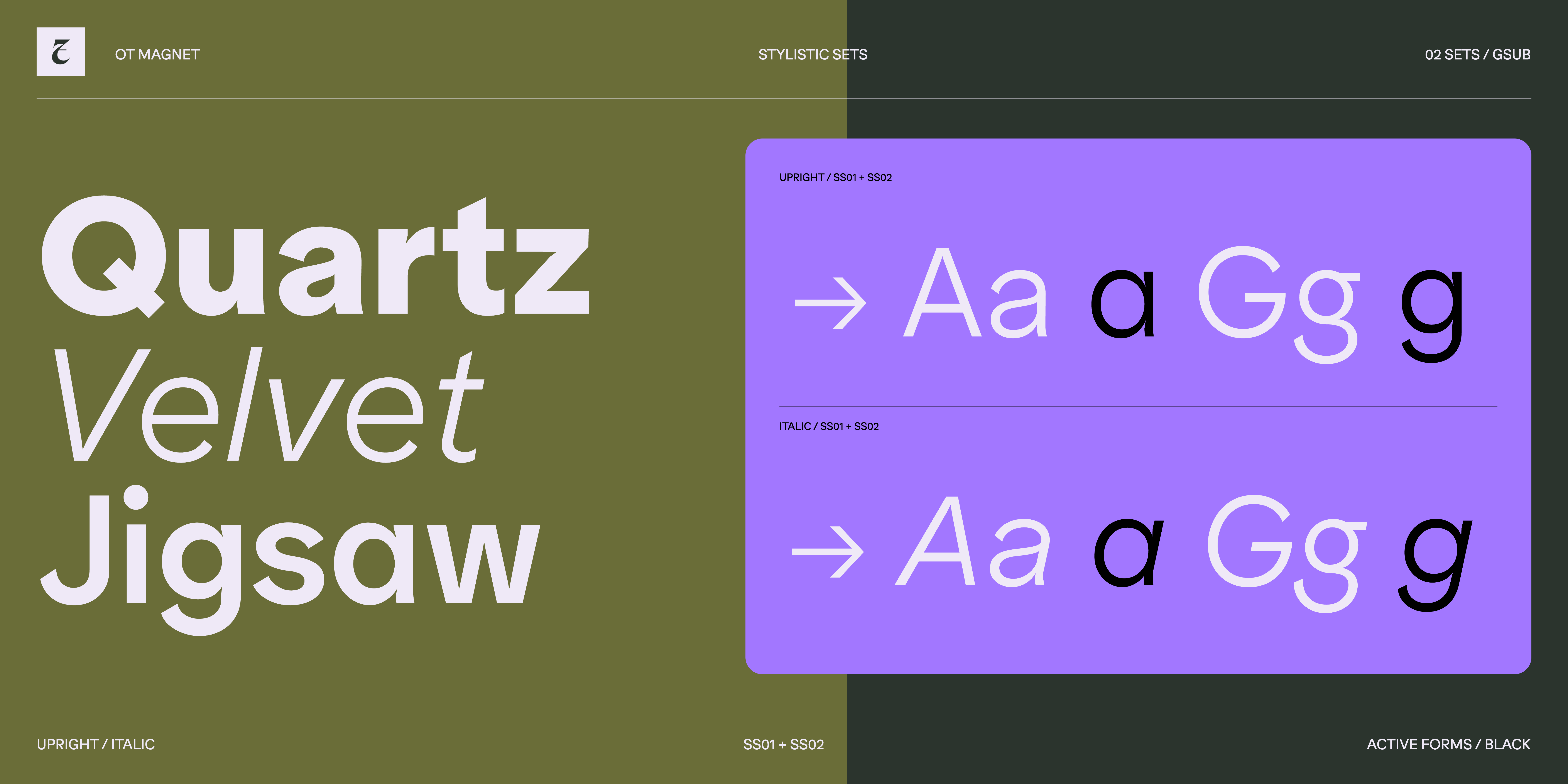
Single-storey ass01
Single-storey gss02
Smaller © and ®ss03
Circled Numbersss10
Black circled numbersss11
Subscriptsubs
Superscriptsups
Tabular Figurestnum
Slashed Zerozero

Supported Languages

134 supported

Latin · Latin Extended · Symbols

  • Afar
  • Afrikaans
  • Aragonese
  • Asu
  • Asturian
  • Azeri
  • Bemba
  • Bena
  • Bosnian
  • Catalan
  • Cebuano
  • Chiga
  • Corsican
  • Czech
  • Welsh
  • Danish
  • Taita
  • German
  • Lower Sorbian
  • Jola-Fonyi