OT Ravelin

01

Type Tester

Editable
Size280px
Weightwght200
Light
Size205px
Leading0.88
Tracking-2
Align
Flow
Bergamot
Weightwght200
Light Italic
Size339px
Leading0.88
Tracking-2
Align
Flow
Neroli
Weightwght200
Book
Size382px
Leading0.88
Tracking-2
Align
Flow
Orris
Weightwght300
Book Italic
Size183px
Leading0.88
Tracking-2
Align
Flow
Labdanum
Weightwght300
Regular
Size225px
Leading0.88
Tracking-2
Align
Flow
Tincture
Weightwght400
Regular Italic
Size172px
Leading0.88
Tracking-2
Align
Flow
Maceration
Weightwght400
Medium
Size269px
Leading0.88
Tracking-2
Align
Flow
Accord
Weightwght550
Medium Italic
Size280px
Leading0.88
Tracking-2
Align
Flow
Sillage
Weightwght550
Bold
Size259px
Leading0.88
Tracking-2
Align
Flow
Extrait
Weightwght700
Bold Italic
Size204px
Leading0.88
Tracking-2
Align
Flow
Atomiser
Weightwght700
Black
Size221px
Leading0.88
Tracking-2
Align
Flow
Absolue
Weightwght850
Black Italic
Size259px
Leading0.88
Tracking-2
Align
Flow
Flacon
Weightwght850
Heavy
Size196px
Leading0.88
Tracking-2
Align
Flow
Resinoid
Weightwght1000
Heavy Italic
Size182px
Leading0.88
Tracking-2
Align
Flow
Drydown
Weightwght1000

Cold expression

Book · Reading text
Size18px
Leading1.34
Tracking0
Align
Flow
Fresh bergamot peel holds fragrant oil in thousands of tiny pockets just beneath the coloured rind. For perfumery, the fruit is processed soon after harvest, while the peel is still supple and the volatile material remains vivid. Modern expression equipment separates the outer zest from juice and pith, then uses gentle mechanical pressure and water to release an emulsion of oil. Centrifuges divide that mixture until the aromatic fraction can be collected on its own. The first liquid is intensely green, bitter and bright, with a character far more complex than the shorthand idea of citrus. It contains waxes and pigments as well as the molecules that give bergamot its familiar lift. After filtration, the oil is stored away from heat and light because oxygen slowly changes its profile. Perfumers evaluate each lot before it enters a formula. Weather, cultivar, ripeness and the interval between picking and processing can all shift the balance between peel, floral and tea-like facets. Two samples carrying the same botanical name may therefore behave differently once diluted. The material is treated less like a fixed flavour than an agricultural ingredient with a season, a place and a measurable variation from one harvest to the next.
Weightwght300

Blotter interval

Book · Large reading
Size26px
Leading1.28
Tracking0
Align
Flow
A fragrance is rarely judged at a single moment. A measured drop is placed on an absorbent blotter, marked with the formula and time, then revisited as the most volatile materials leave the strip. The opening may be dominated by citrus peel, herbs or aldehydic brightness; an hour later the centre can feel warmer, softer and more connected. By the next morning, woods, resins, musks and traces of floral material remain close to the paper. Evaluators keep the strips separated so one formula does not contaminate another, and they compare them under neutral conditions rather than against freshly sprayed skin. Notes are brief and practical: too sharp at ten minutes, hollow after two hours, richer on the second day. The sequence matters because a perfume is designed as an evaporation curve, not as a still mixture in a bottle.
Weightwght300

Orris years

Regular · Reading text
Size18px
Leading1.34
Tracking0
Align
Flow
The iris used in fine fragrance is valued for what happens after the plant leaves the ground. Its rhizomes are lifted, washed and trimmed, then dried and stored for a long maturation that can last several years. During that quiet interval, precursor compounds gradually transform and the material develops the powdery, violet-like character associated with orris. The dried rhizomes become hard and pale, with little resemblance to the soft flower above them. When they are finally processed, they are milled and distilled to produce a waxy material traditionally called orris butter. At room temperature it can be almost solid. Dilution reveals a different scale of detail: cool root, faint wood, violet, suede and a soft mineral dryness. The yield is low, the waiting period is long and the crop itself occupies land for seasons before harvest, which is why true orris is used carefully. A perfumer may add only a small amount, not to make a formula smell recognisably of iris, but to smooth a transition between floral, woody and musky materials. Its effect is often structural. It can soften an edge, extend a pale floral note or give dry ingredients a tactile, almost cosmetic finish that becomes clearer after the brighter materials have evaporated.
Weightwght400

Amber tincture

Regular · Large reading
Size26px
Leading1.28
Tracking0
Align
Flow
A tincture begins with patience rather than heat. Dry aromatic material is broken into a controlled size, weighed, covered with alcohol and sealed in glass or stainless steel. The solvent moves slowly through the material, dissolving fragrant compounds while heavier particles settle. Over days or weeks the liquid changes colour and the aroma becomes deeper. The vessel is turned or stirred at planned intervals, then the extract is filtered until it is clear enough for evaluation. Tincturing can preserve delicate shades that would be altered by a hotter process, but it also carries the texture of the raw material into the result. Vanilla may become darker and more balsamic; resins can yield smoke, sweetness and dry mineral facets in the same liquid. The finished tincture is labelled by material, strength and date so later trials can be reproduced rather than remembered.
Weightwght400

Formula by mass

Medium · Reading text
Size18px
Leading1.34
Tracking0
Align
Flow
A perfume formula is recorded by mass so the same balance can be rebuilt at any scale. Each material has a code, a concentration and a target weight. The concentrate is assembled from the smallest additions upward because a trace ingredient is easier to correct before the larger quantities enter the vessel. Dense resins may be pre-diluted; crystalline materials are warmed only enough to dissolve; volatile liquids are kept covered between measurements. After every addition the running total is checked against the formula rather than against memory. A difference of a few hundredths of a gram may be irrelevant in a large base but decisive when the ingredient has enormous odour strength. Once the concentrate is complete, it is mixed until no visible streak or sediment remains and a small sample is set aside. Only then is alcohol introduced to reach the intended strength. The fresh dilution can smell disjointed, with individual ingredients more obvious than they will be later, so the first evaluation is recorded without treating it as a verdict. A retained sample from each modification makes comparison possible. If version twelve feels drier than version eleven, the change can be traced to an exact adjustment instead of reconstructed from recollection. The formula becomes a history of decisions as well as a recipe.
Weightwght550

Glass and closure

Medium · Large reading
Size26px
Leading1.28
Tracking0
Align
Flow
Before perfume reaches a finished bottle, the glass and closure are checked as parts of the formula’s environment. A flacon must stand level, accept the pump cleanly and protect the liquid from contamination during filling. Small variations in the neck can affect the crimp that locks the pump in place, so sample bottles are tested for seal strength before a production run. The dip tube is cut to reach the base without curling against the glass. After filling, bottles are weighed, crimped and inverted briefly to expose leaks that would otherwise appear only in transport. The first spray is also examined: the pump should prime predictably and produce a fine, repeatable mist rather than a narrow jet. Decoration comes after function. Lacquer, screen printing, labels and caps can change the object dramatically, but none should interfere with the seal, the spray path or the stability of the fragrance inside.
Weightwght550

Carton register

Case-sensitive punctuation
Size72px
Leading1.02
Tracking-0.5
Align
Flow
PARFUM [50 ML] — BATCH 27 / 18°C
Weightwght550

Formula fractions

Composed fractions
Size64px
Leading1.05
Tracking0
Align
Flow
Orris 1/8 · Neroli 3/16 · Benzoin 5/32 · Vetiver 7/16
Weightwght400

Maceration log

Tabular figures
Size58px
Leading1.12
Tracking0
Align
Flow
LOT 031 18.40 21°C LOT 108 07.25 19°C LOT 246 42.00 20°C LOT 517 13.75 18°C
Weightwght300

Reifezeit

Deutsch
Size52px
Leading1.12
Tracking0
Align
Flow
Während das Duftkonzentrat ruht, verbinden sich Iris, Bergamotte und Harze zu einem ruhigeren Akkord; nach einigen Tagen wirkt die Mischung runder, kühler und deutlich ausgewogener.
Weightwght400
02

Glyph Map

Loading Light…
AU+0041
100%
Glyph name
—
Unicode
U+0041
Decimal
65
Advance
—
Sidebearings
—
01/09

Specimens

2:1
OT Ravelin: OT Ravelin specimen artwork — Contrast field
04

Information

2026

Family

OT Ravelin

Serif
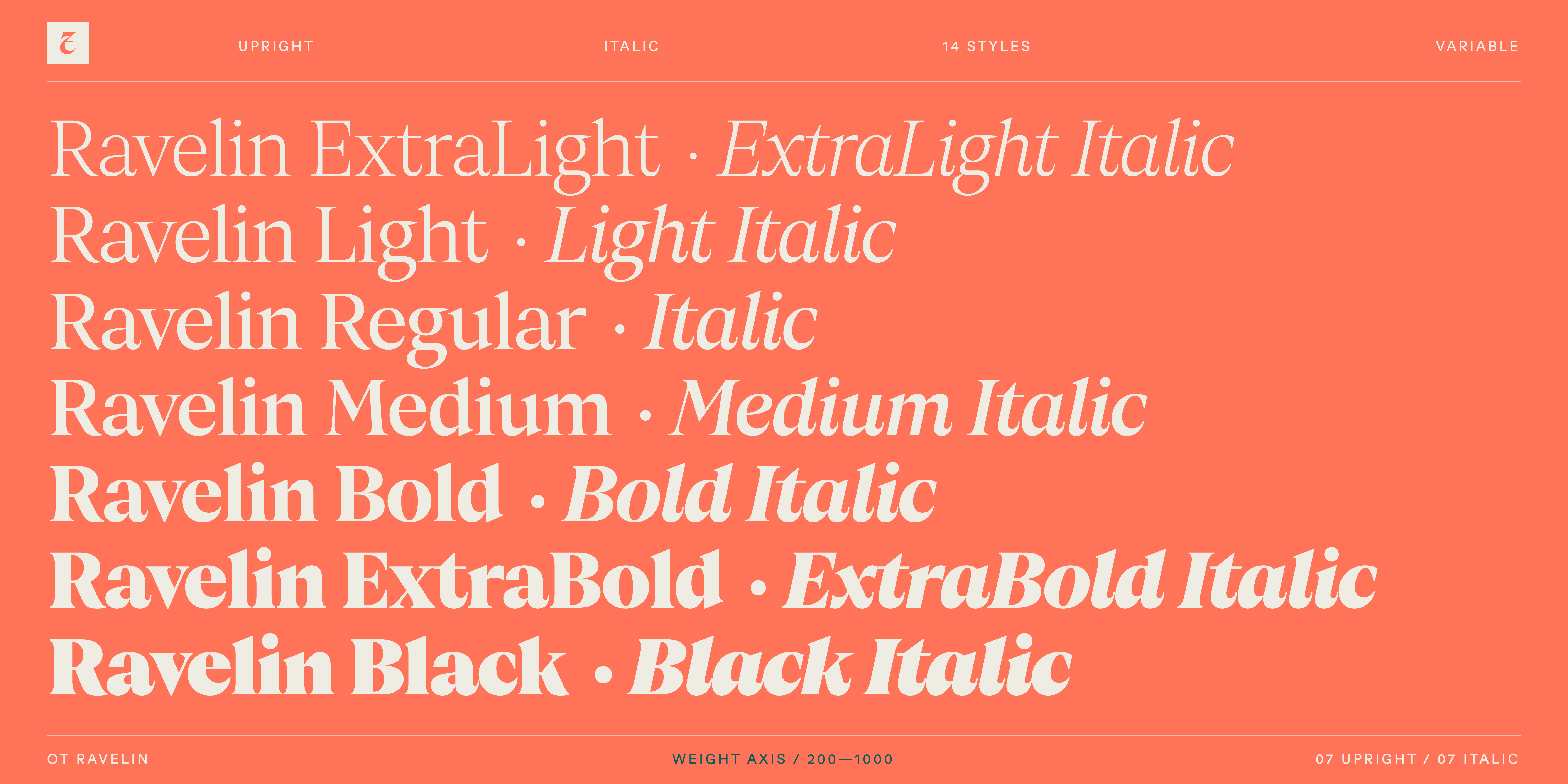
14 styles
Latin, Latin Extended
Released 2026

Variable and static OpenType formats.

OT Ravelin

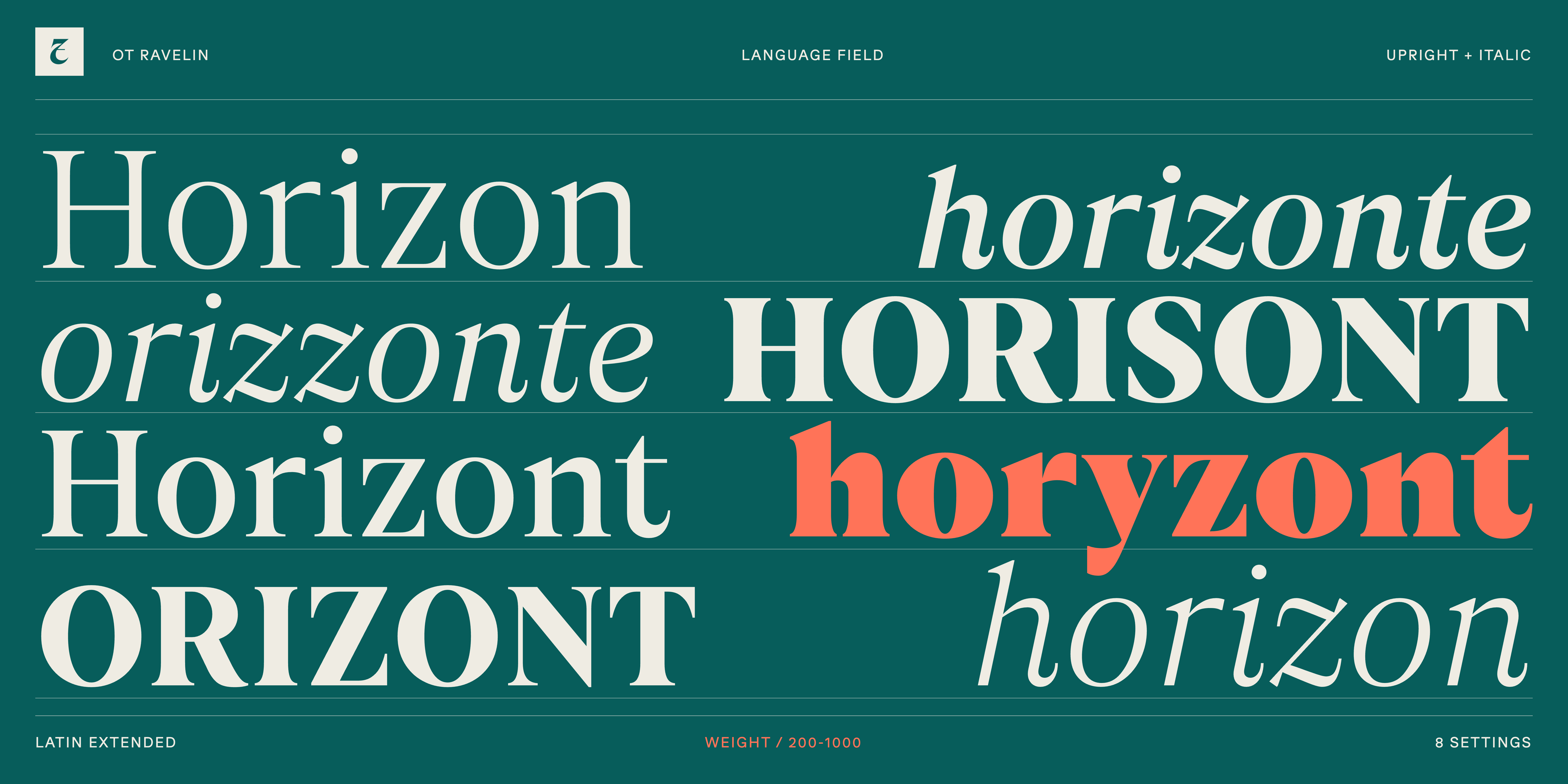
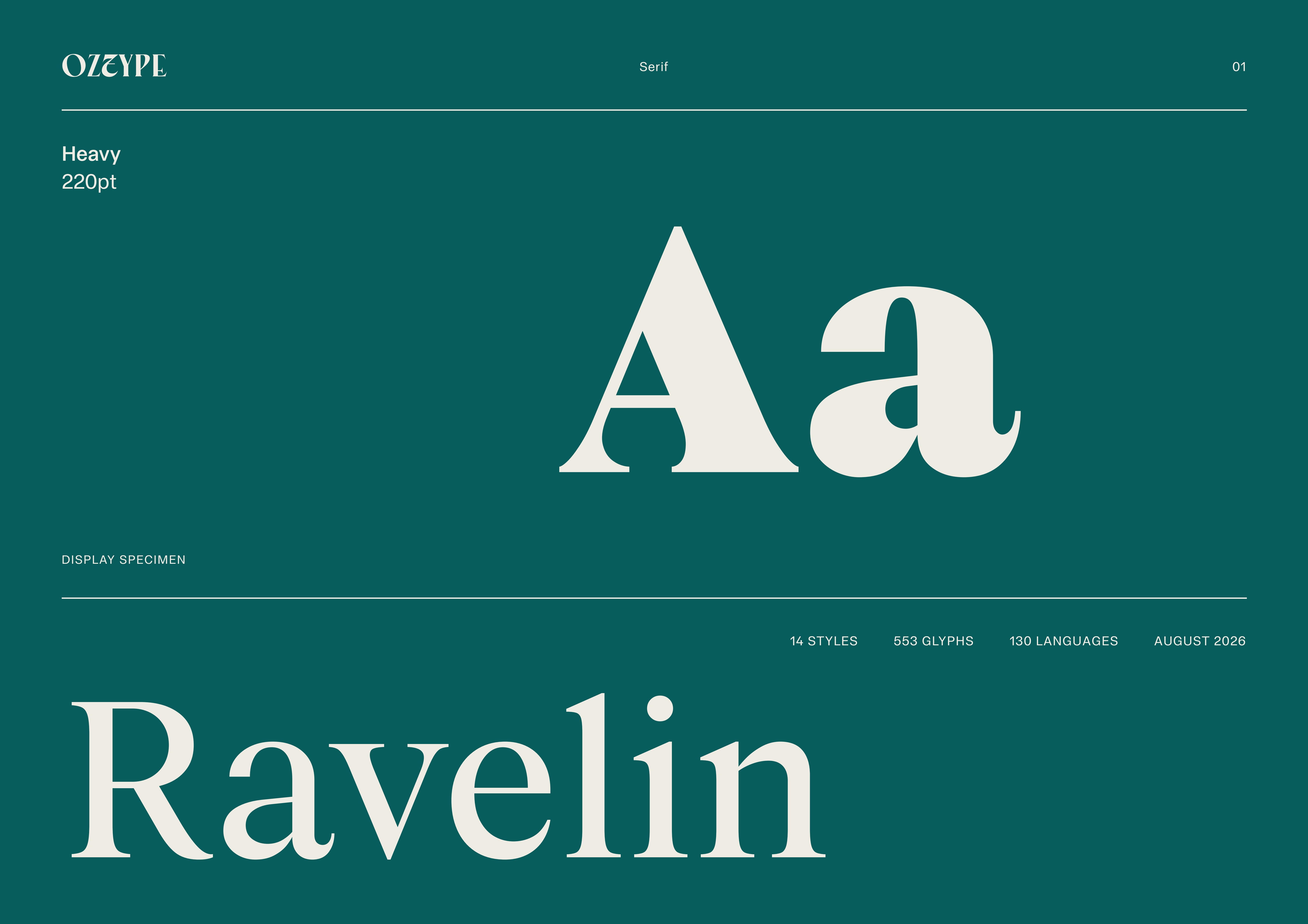
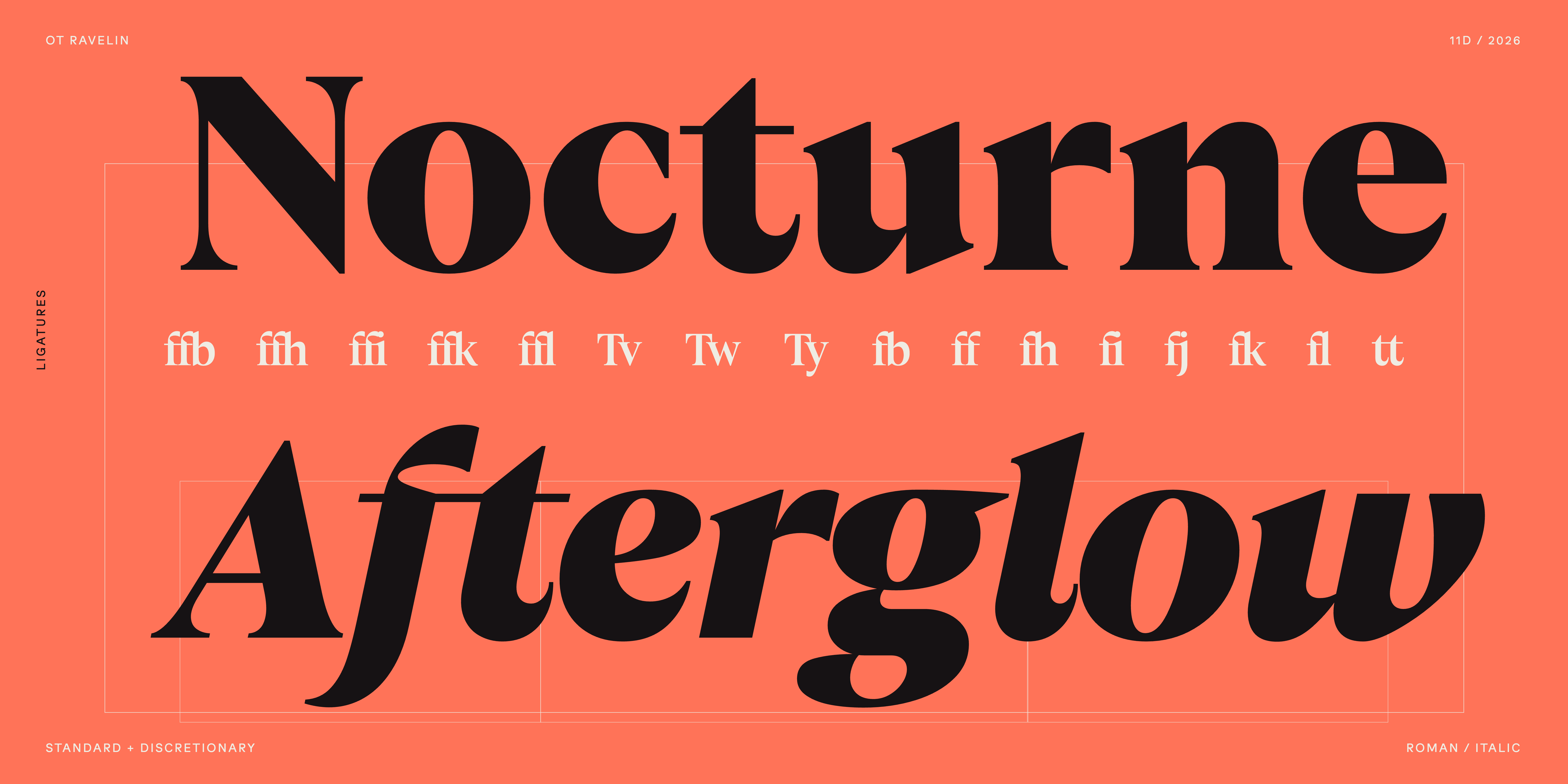
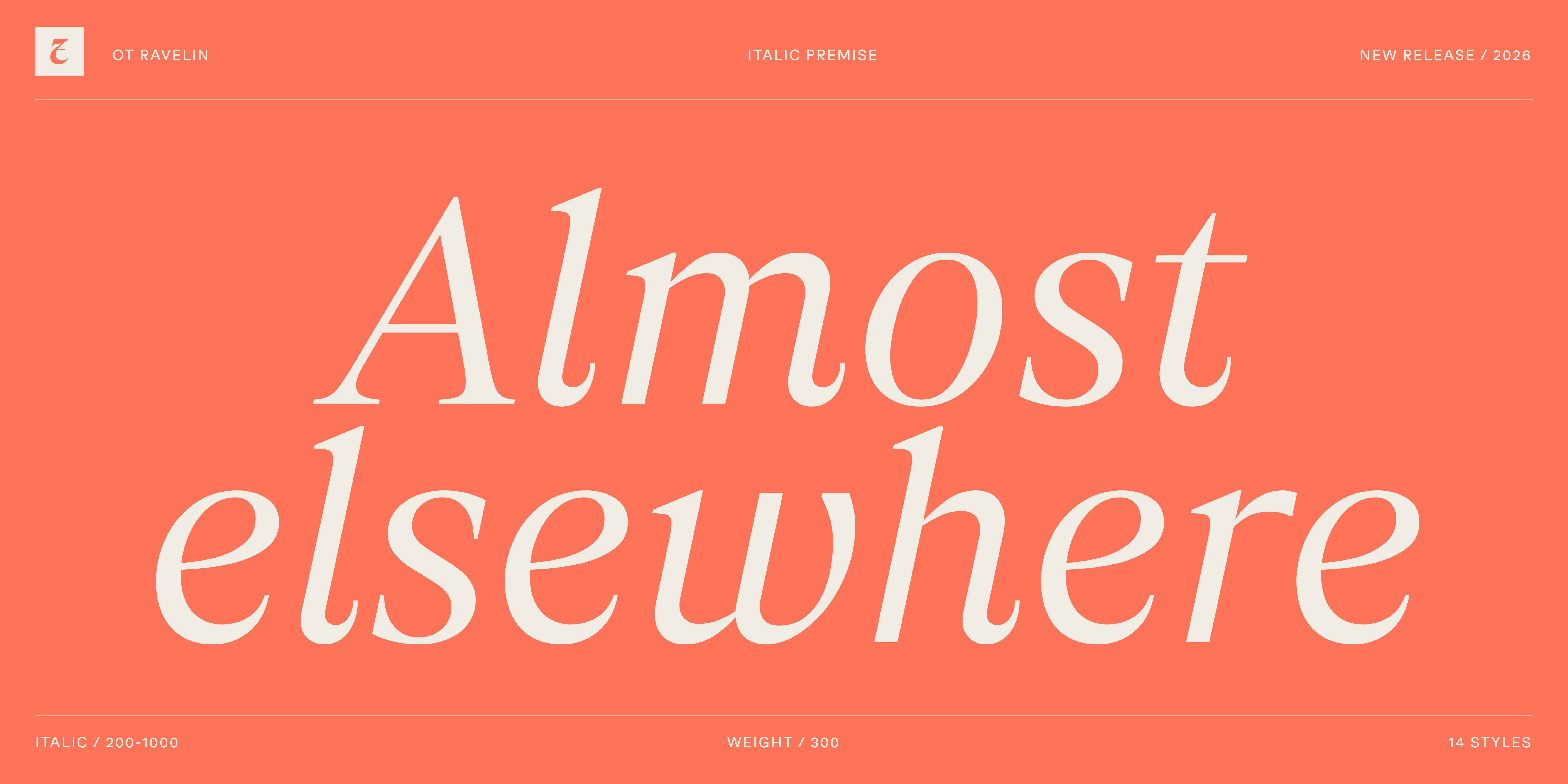
OT Ravelin is a high-contrast serif family available in 14 styles and two variable fonts, shifting effortlessly from luminous, blade-thin hairlines to commanding sculptural headlines. Its structured uprights feature sharp triangular serifs and a single-storey 'g', while its separately drawn italics inject an energetic, calligraphic rhythm into editorial systems. Optimized with extensive Latin Extended support and full OpenType features, it is a sophisticated choice for packaging, cultural publishing, and identity work.

Technical

Metrics

Reading font data…

Axes

Variable axes: Weight (wght) 200–1000.

Features

OpenType layout data is included in the font files.

Credits

Designed and released by Oztype in 2026.

Information

2026

Family

OT Ravelin

Classification
Serif
Styles
14 styles
Format
Variable + static OpenType
Scripts
Latin, Latin Extended
Designers
Isla Thompson, Oussama Horchani
OT Ravelin PDF specimen cover
Download PDF specimen
Get trial fonts

About

OT Ravelin is a high-contrast serif family available in 14 styles and two variable fonts, shifting effortlessly from luminous, blade-thin hairlines to commanding sculptural headlines. Its structured uprights feature sharp triangular serifs and a single-storey 'g', while its separately drawn italics inject an energetic, calligraphic rhythm into editorial systems. Optimized with extensive Latin Extended support and full OpenType features, it is a sophisticated choice for packaging, cultural publishing, and identity work.

Specifications

Glyphs
553

Variable axes

Weightwght200 — 1000

OpenType features

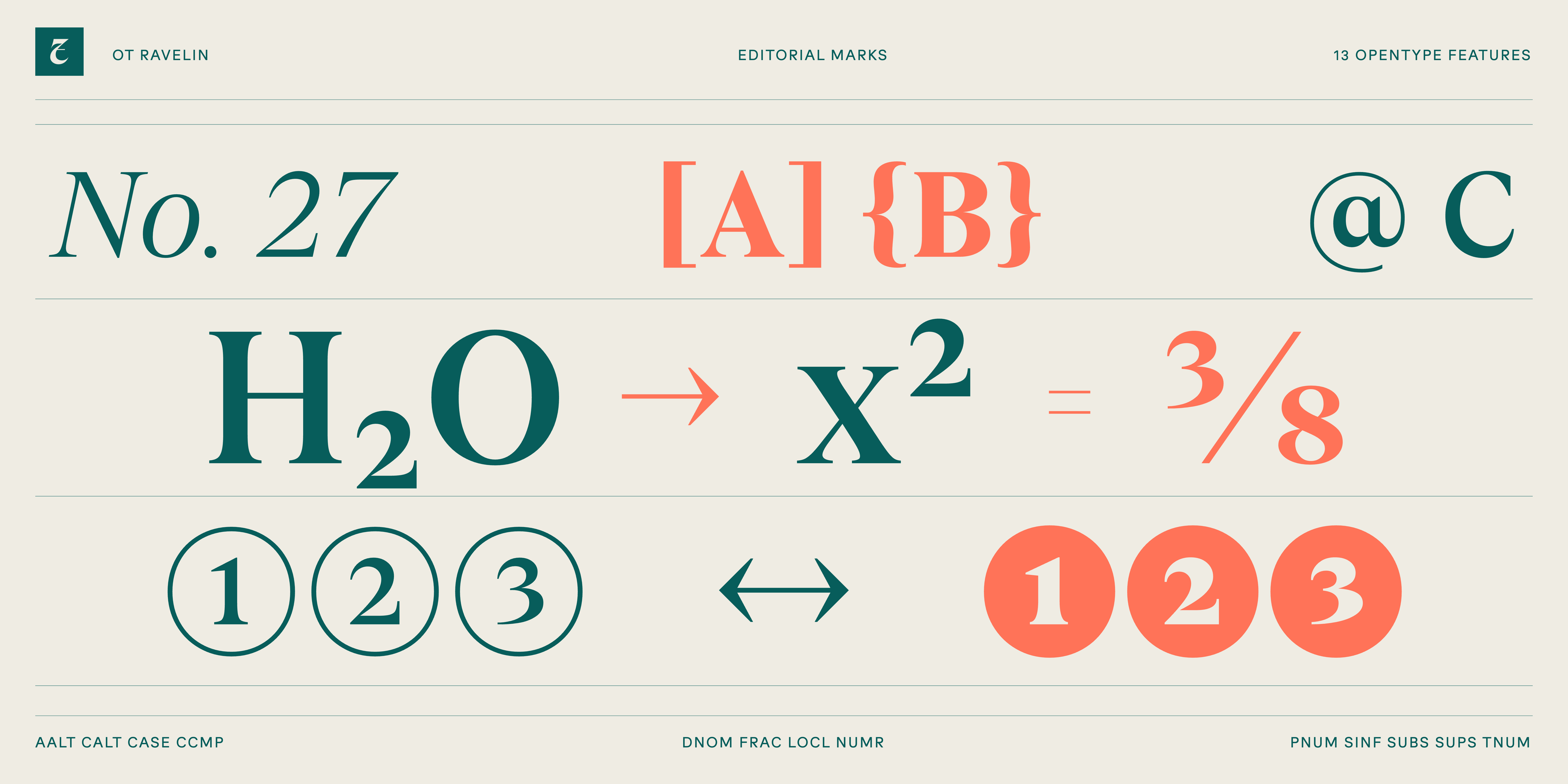
Access All Alternatesaalt
Contextual Alternatescalt
Case-Sensitive Formscase
Glyph Composition / Decompositionccmp
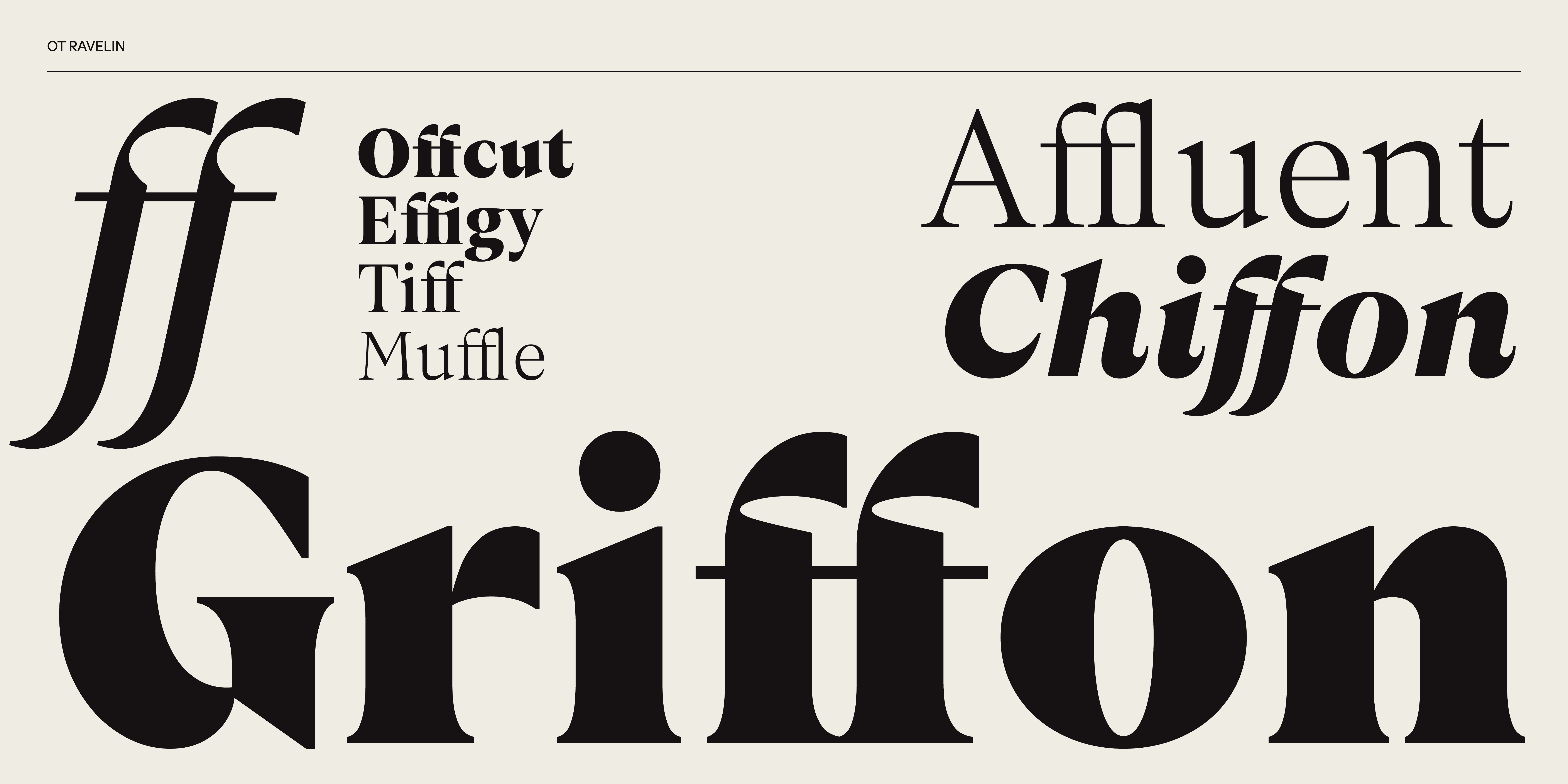
Discretionary Ligaturesdlig
Denominatorsdnom
Fractionsfrac
Kerningkern
Standard Ligaturesliga
Localized Formslocl
Numeratorsnumr
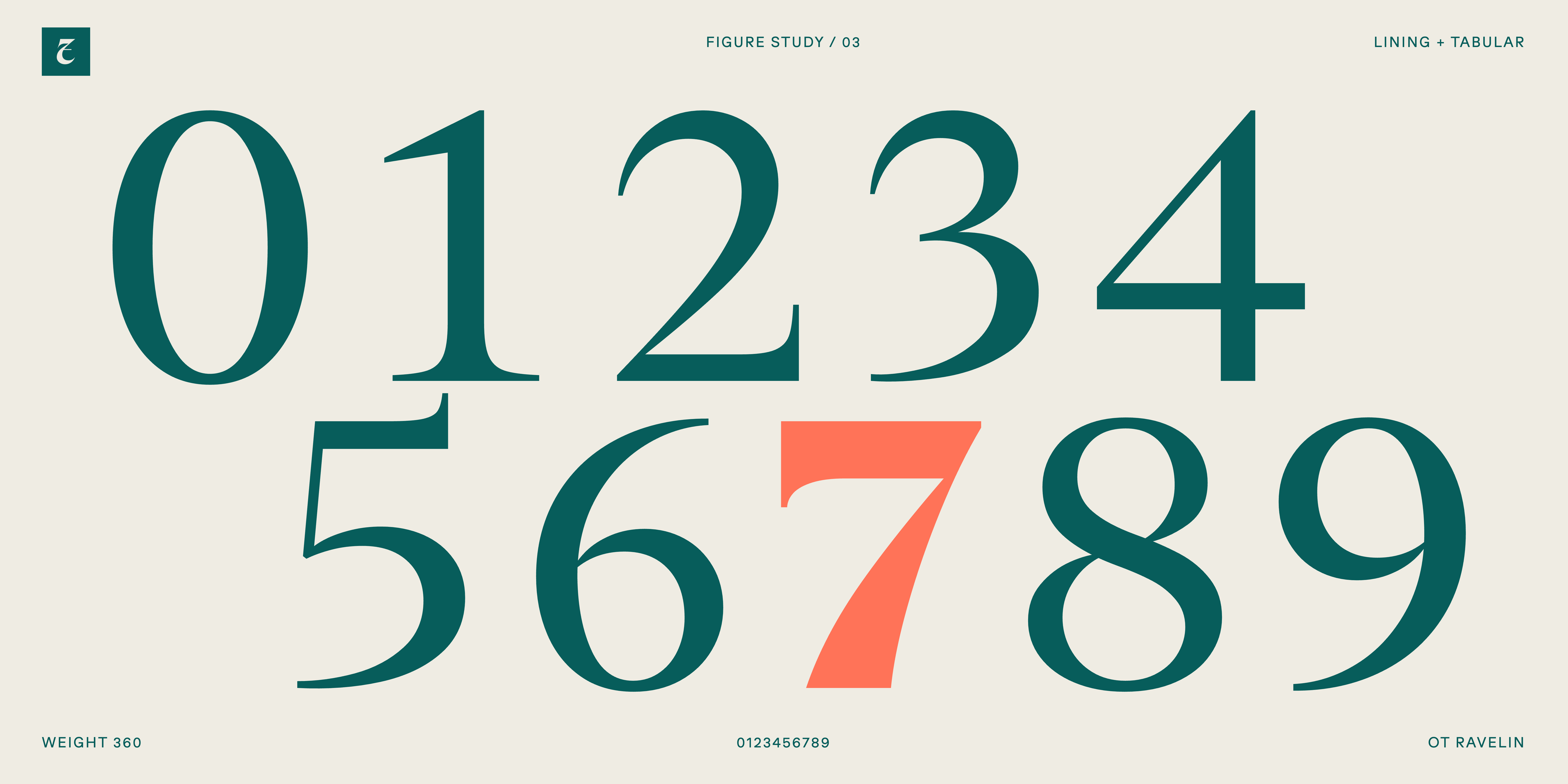
Proportional Figurespnum
Scientific Inferiorssinf
Subscriptsubs
Superscriptsups
Tabular Figurestnum

Supported Languages

130 supported

Latin · Latin Extended

  • Afar
  • Afrikaans
  • Aragonese
  • Asu
  • Azeri
  • Bemba
  • Bena
  • Bosnian
  • Catalan
  • Cebuano
  • Chiga
  • Corsican
  • Czech
  • Welsh
  • Danish
  • Taita
  • German
  • Lower Sorbian
  • Jola-Fonyi
  • Embu