OT Replica

01

Type Tester

Editable
Size280px
Weightwght400
Italicital0

Thin

Thin
Size280px
Leading0.92
Tracking-3
Align
Flow
Daybreak
Weightwght100
Italicital0

Thin Italic

Thin Italic
Size278px
Leading0.92
Tracking-3
Align
Flow
Afterglow
Weightwght100
Italicital1

Extralight

Extralight
Size251px
Leading0.92
Tracking-3
Align
Flow
Uncharted
Weightwght200
Italicital0

Extralight Italic

Extralight Italic
Size248px
Leading0.92
Tracking-2
Align
Flow
Elsewhere
Weightwght200
Italicital1

Light

Light
Size245px
Leading0.92
Tracking-3
Align
Flow
Crosswind
Weightwght300
Italicital0

Light Italic

Light Italic
Size243px
Leading0.92
Tracking-2
Align
Flow
Éphémère
Weightwght300
Italicital1

Book

Book
Size208px
Leading0.92
Tracking-3
Align
Flow
Northbound
Weightwght350
Italicital0

Book Italic

Book Italic
Size220px
Leading0.92
Tracking-2
Align
Flow
Wandering
Weightwght350
Italicital1

Regular

Regular
Size212px
Leading0.92
Tracking-3
Align
Flow
Everywhere
Weightwght400
Italicital0

Regular Italic

Regular Italic
Size239px
Leading0.92
Tracking-2
Align
Flow
Moonlight
Weightwght400
Italicital1

Medium

Medium
Size247px
Leading0.92
Tracking-3
Align
Flow
Overnight
Weightwght500
Italicital0

Medium Italic

Medium Italic
Size237px
Leading0.92
Tracking-2
Align
Flow
Driftwood
Weightwght500
Italicital1

Semibold

Semibold
Size206px
Leading0.92
Tracking-3
Align
Flow
Undercover
Weightwght600
Italicital0

Semibold Italic

Semibold Italic
Size228px
Leading0.92
Tracking-2
Align
Flow
Midwinter
Weightwght600
Italicital1

Bold

Bold
Size237px
Leading0.92
Tracking-3
Align
Flow
Headlines
Weightwght700
Italicital0

Bold Italic

Bold Italic
Size214px
Leading0.92
Tracking-2
Align
Flow
Afterhours
Weightwght700
Italicital1

Black

Black
Size184px
Leading0.92
Tracking-3
Align
Flow
Thunderbolt
Weightwght800
Italicital0

Black Italic

Black Italic
Size225px
Leading0.92
Tracking-2
Align
Flow
Unfiltered
Weightwght800
Italicital1

Light · 3 columns

Light · 18px · 3 columns
Size18px
Leading1.42
Tracking0
Align
Flow
Before sunrise the market square belongs to delivery vans, street cleaners and the first bakers lifting their shutters. A florist carries buckets of stems from the back of a small truck while a café owner drags metal chairs into two neat rows. The fountain is still switched off, so every sound travels farther than it will later in the day. Someone rolls a bicycle across the stones. Someone else unlocks a newspaper stand and begins sorting the morning editions into a bright, uneven fan. By seven the square has changed character. Commuters cross it diagonally toward the tram stop, schoolchildren gather around the bakery window, and the smell of coffee begins to overpower the damp air. The flower stall opens first, followed by fruit and vegetables, old books, kitchen tools and a man who sells nothing but buttons in shallow wooden trays. Regular customers arrive without asking prices. They know where everything will be and which seller has kept something aside. The busiest hour comes just before noon. Tables spread across the pavement, scooters appear in every gap, and the narrow lane beside the church becomes almost impossible to cross. Tourists stop in the middle to study a map while residents move around them without slowing down. A violinist takes up a place beneath the arcade and repeats the same three songs until they begin to feel like part of the architecture. Coins land in an open case at his feet. In the afternoon the heat pushes everyone toward the shaded side of the square. The bookseller turns pale covers away from the sun. The florist moves the roses inside. Children run through the fountain after the water begins, leaving dark footprints that disappear almost as quickly as they form. By five the market stalls start packing up, but the cafés become louder. Friends arrive in pairs, then in larger groups, and tables are joined together until the pavement is full again. Nothing announces the end of the day. The light simply changes. Delivery crates vanish, awnings are rolled in, and the last unsold fruit is divided between paper bags. By the time the street lamps come on, the square has become a different room: quieter at the edges, crowded in the middle, and ready to begin another evening.
Weightwght300
Italicital0

Light · 2 columns

Light · 26px · 2 columns
Size26px
Leading1.32
Tracking0
Align
Flow
The ferry left the harbour just after nine, turning slowly between the breakwaters before gathering speed in open water. From the upper deck the city looked flatter than it had from the street. Warehouses, apartment blocks and church towers settled into one long horizon while fishing boats moved in the opposite direction, returning with blue crates stacked along their decks. A family unpacked breakfast from a paper bag beside the window. Two students compared photographs from the night before. Near the stern, an older man stood for almost the entire crossing with both hands resting on the rail. The wind was strong enough to lift pages from a newspaper, but the sea itself remained calm. An hour later the island appeared as a pale line. White houses gathered around the harbour, then separated as the ferry approached. From a distance there seemed to be only a few streets. Up close there were gardens, stairways, workshops, cafés and small squares hidden behind the waterfront. The passengers stepped ashore and disappeared in different directions, each carrying the same brief feeling of arrival.
Weightwght300
Italicital0

Book · 3 columns

Book · 18px · 3 columns
Size18px
Leading1.42
Tracking0
Align
Flow
The night train was scheduled to leave at eleven forty, but the platform filled much earlier. Some passengers arrived with a single bag and nothing to do but wait. Others came surrounded by suitcases, children, folded coats and relatives offering last instructions through open windows. The station announcer repeated the destination in three languages, each version echoing a little longer beneath the glass roof. Inside the carriage the compartments were warmer than expected. Reading lamps cast small circles over books and tickets while the corridor remained almost dark. A conductor moved from door to door checking names against a printed list. Someone had brought oranges; their scent travelled through the coach whenever the connecting door opened. Farther down, a group of friends whispered and tried not to laugh too loudly. The train began moving so gently that several people did not notice until the station lights started sliding past the windows. Warehouses came next, then rows of suburban houses with television screens glowing behind curtains. Within half an hour the city had disappeared. The view outside became a sequence of black fields, occasional roads and isolated service stations shining under fluorescent lights. Around midnight the carriage settled into silence. Shoes were placed beneath seats, jackets became pillows, and curtains were pulled across the windows. The rhythm of the tracks changed whenever the train crossed a bridge or entered a tunnel. At small stations the doors opened for only a minute. A few new passengers climbed aboard carrying cold air with them, found their places, and vanished into the quiet. Just before dawn, people began waking without speaking. The landscape had changed during the night. Hills appeared beyond the fields and low clouds hung over the villages. Coffee arrived on a trolley in paper cups. Phones were switched back on. The compartment that had felt private for several hours became public again as bags were zipped and beds folded away. The final approach followed a river into the centre of the city. Cyclists waited at crossings. Bakery lights were already on. On balconies, laundry moved slightly in the morning air. When the train stopped, everyone stood at once, forming a slow line in the corridor. A few minutes later the carriage was empty except for newspapers, cups and the temporary disorder left behind by a night in motion.
Weightwght350
Italicital0

Book · 2 columns

Book · 26px · 2 columns
Size26px
Leading1.32
Tracking0
Align
Flow
At the end of the avenue, the old cinema still keeps its original sign. Half of the bulbs no longer work, but the letters are large enough to read from several blocks away. The ticket booth has been converted into a tiny coffee counter, and the lobby walls are covered with photographs from films that played there decades ago. The main auditorium opens only in the evenings. During the day, sunlight enters through emergency doors and reveals the faded pattern of the carpet. Seats in the back rows have been repaired with fabric that almost matches the original. The screen is smaller than those in new multiplexes, yet the room makes every image feel unusually close. On Fridays there is always a queue outside. Some people come for the film; others seem to come for the ritual of waiting, choosing seats, talking quietly while the lights dim and staying through the credits. When the audience finally steps back into the street, the avenue has changed. Shops are closed, buses are less frequent, and the cinema sign becomes the brightest thing on the block.
Weightwght350
Italicital0

Regular · 3 columns

Regular · 18px · 3 columns
Size18px
Leading1.42
Tracking0
Align
Flow
The apartment faces an interior courtyard that cannot be seen from the street. To reach it, visitors pass through a narrow entrance, cross a tiled hall and climb one flight of stairs before the building opens suddenly toward the sky. Balconies run around all four sides. Plants spill over railings. Laundry lines cross above the ground floor like temporary flags. Every window seems to have its own schedule. The baker downstairs wakes first and switches on his kitchen light before five. At six, someone on the third floor waters a row of herbs. Around seven thirty, doors begin opening and closing as people leave for work. A radio plays from an apartment near the stairs, always tuned to the same morning programme. By midday the courtyard is almost still. Sunlight reaches the centre but leaves the walls in shade. A cat sleeps beneath a parked bicycle. Delivery workers call apartment numbers from the entrance and wait for voices to answer from above. The baker stacks empty flour sacks near the bins and sits outside for ten minutes before beginning the afternoon batch. Children return from school in the late afternoon and immediately change the acoustics of the building. A ball strikes the wall, someone shouts from a balcony, another voice answers from a kitchen. Neighbours exchange groceries across landings. The cat moves to a safer place beneath a bench. For an hour the courtyard becomes the centre of the building rather than the empty space inside it. Dinner arrives as a collection of smells rather than a single event. Garlic, tomatoes, toasted bread and something sweet drift between floors. Windows remain open until the air cools. Conversations that began indoors migrate to balconies. The building is close enough that nobody needs to raise a voice very far. Later, lights go out one by one. The bakery begins again long before the final apartment is dark. Through the night there is always some small evidence that the building is awake: a bathroom light, a door closing softly, footsteps crossing the tiles below. By morning the routine has reset itself, similar to the day before but never exactly the same.
Weightwght400
Italicital0

Regular · 2 columns

Regular · 26px · 2 columns
Size26px
Leading1.32
Tracking0
Align
Flow
The road to the coast leaves the city through a district of workshops, petrol stations and furniture warehouses before narrowing between low hills. For the first twenty kilometres there is little to suggest the sea is nearby. Then the air changes, the horizon opens, and flashes of blue appear between olive trees. Small towns interrupt the drive every few minutes. Each has a café facing the road, a pharmacy sign and a cluster of scooters parked near the centre. At one junction a handwritten board points toward a beach that does not appear on any map. We turn without discussing it. The road becomes rougher and ends beside a line of dunes. There are no umbrellas, no restaurants and almost no people. A fisherman has left a wooden boat above the tide line. Farther down, three children are building a wall from wet sand while their parents sit under a sheet tied between two poles. We stay until the afternoon wind arrives. By then the footprints around us have softened and the water has moved several metres up the beach. On the drive back, every town looks more familiar than it did that morning.
Weightwght400
Italicital0

Medium · 3 columns

Medium · 18px · 3 columns
Size18px
Leading1.42
Tracking0
Align
Flow
The library occupies a former post office at the corner of two busy streets. Its stone façade still carries the outline of letters removed decades ago, and the old sorting hall now holds long reading tables beneath a ceiling of steel and glass. Nothing about the building was designed for silence, yet the sound of traffic seems to disappear as soon as the doors close. The ground floor is arranged around movement. Newspapers, returns, information desks and new books sit closest to the entrance. Students pass through quickly on their way upstairs, while regular visitors stop to speak with staff who know exactly which shelves they will visit. A staircase curves around the former service counter and leads to quieter rooms above. On the first floor, windows run almost the full height of the walls. Desks have been placed between the columns so that every seat receives daylight. Some people arrive with laptops and headphones. Others bring notebooks, dictionaries or stacks of photocopied pages. The room changes character throughout the day without ever becoming completely empty. Afternoons belong to school groups. Tables fill with bags, pencils and half-finished drinks. Questions travel in whispers from one end of a row to the other. Near the reference shelves, a librarian moves steadily between students, answering one question at a time and returning books to a trolley that seems permanently full. The upper floor contains the smallest collections and the longest stays. Local archives occupy compact shelves along one wall. Maps lie flat in wide drawers. Boxes of letters and photographs can be requested at a desk and opened only with clean hands. Researchers measure their days in folders rather than hours. At closing time the building does not empty all at once. Chairs scrape back slowly. Pages are marked. Chargers disappear into bags. Outside, buses continue past the entrance and the intersection grows louder again. Inside, the last books are gathered from the tables and sorted for another morning.
Weightwght500
Italicital0

Medium · 2 columns

Medium · 26px · 2 columns
Size26px
Leading1.32
Tracking0
Align
Flow
The restaurant has twelve tables and a kitchen that can be seen through a wide opening behind the counter. At lunchtime the room fills quickly with office workers, delivery riders and neighbours who already know what they want. The menu is written on a board and changes according to what arrived at the market that morning. There is no music. Instead, the room has the sound of plates, short conversations and the bell that rings whenever an order is ready. The owner moves between tables carrying bread and remembering who asked for extra lemon. Two cooks work almost without speaking. After two, the rush disappears. Chairs are straightened, the floor is swept and the kitchen door is left open to the alley. Staff sit together at the largest table for their own meal. For twenty minutes the restaurant feels less like a business than a dining room. By evening the board has been rewritten. Some dishes are crossed out, a new one has been added, and the room begins filling again. The same twelve tables produce an entirely different atmosphere under the warmer lights.
Weightwght500
Italicital0

Semibold · 3 columns

Semibold · 18px · 3 columns
Size18px
Leading1.42
Tracking0
Align
Flow
The community radio station broadcasts from the second floor of a building above a hardware shop. Its entrance is easy to miss: a narrow staircase, a blue door and a small paper sign listing the frequency. Inside, three studios share a corridor lined with posters from concerts, neighbourhood meetings and programmes that ended years ago. The morning presenter arrives before anyone else. She switches on the corridor lights, checks messages from listeners and prepares a short list of local announcements. Weather, road closures, school events and lost pets are read with the same calm attention. Between records, the microphone picks up the faint click of buttons on the control desk. By ten the station becomes crowded. Volunteers arrive carrying notebooks, cables and coffee. One studio hosts an interview with a theatre group while another records a language programme for the weekend. The smallest room is used for editing. Its walls are covered with dark acoustic foam, and the only window looks into the corridor. Lunch is informal and usually late. Someone brings sandwiches from downstairs. Guests wait on mismatched chairs beside shelves of old recordings. The station manager answers emails from a desk pushed against the wall. Every few minutes a red light above one of the doors turns on and the corridor becomes quiet. Afternoon programmes are more unpredictable. School students present music they have chosen themselves. A historian answers questions about old street names. Local musicians perform with instruments arranged around a single microphone. Technical mistakes are common and rarely disastrous. The station's character depends partly on the fact that listeners can hear people working things out. After dark, the building grows quiet again. The hardware shop closes, traffic thins and the final presenter speaks to an audience he cannot see. When the last programme ends, the transmitter continues carrying a recorded playlist through the night. Upstairs, the studios are dark, but the station never entirely stops.
Weightwght600
Italicital0

Semibold · 2 columns

Semibold · 26px · 2 columns
Size26px
Leading1.32
Tracking0
Align
Flow
The first rain arrived in the middle of the night and continued until morning. By breakfast the gutters were full, buses moved slowly through the main road and every café entrance had become a collection of umbrellas. People who had spent months complaining about the heat now stood beneath awnings waiting for the weather to change again. At the market, sellers pulled plastic sheets across their stalls and moved boxes away from the edges. The fishmonger worked as usual. The bookseller did not open at all. Children stepped deliberately into every deep puddle while adults took long routes around them. By early afternoon the clouds lifted. Water still ran along the kerbs, but shutters opened and chairs returned to pavements. The city looked briefly washed clean. Colours seemed stronger, dust had disappeared from leaves, and the air carried the cool smell of stone after rain. The following morning was bright again. Only a few damp walls and a broken branch in the square showed how different the previous day had been.
Weightwght600
Italicital0

Bold · 3 columns

Bold · 18px · 3 columns
Size18px
Leading1.42
Tracking0
Align
Flow
The annual night market begins after sunset and occupies five streets that are normally open to traffic. Barriers appear in the afternoon, followed by cables, temporary lights and rows of folding tables. By six, shopkeepers have moved displays outside and food stalls are already sending smoke above the rooftops. The first hour belongs to families. Children carry paper lanterns, grandparents move carefully through the crowd and everyone seems to stop at the same stall selling hot flatbread. Musicians tune instruments on a small platform near the old gate. Their sound check competes with generators, conversations and vendors calling to passing customers. Later, the streets become difficult to cross. Friends arrange meeting points and immediately lose one another. Queues form for grilled fish, sweet pastries and coffee served from metal pots. Craftspeople demonstrate printing, weaving and wood carving beneath bright work lamps. A photographer hangs portraits from clips along a wire and takes new pictures against a painted backdrop. Around ten the music grows louder. The platform that looked too small at the start of the evening becomes the centre of the market. People stand on steps and low walls to see. Restaurant windows remain open, and waiters carry trays through gaps that appear and close within seconds. Midnight brings the first signs of ending. Families leave, musicians pack instruments and sellers begin counting what remains. Some stalls offer lower prices rather than carry stock home. Street cleaners wait behind the barriers with carts and brooms while the final customers move slowly toward the exits. By two the lights are coming down. Tables fold, cables are coiled and vans return to streets that had seemed completely transformed only a few hours earlier. Before dawn, traffic is moving again. Apart from a few scraps of paper caught against the kerb, there is almost no evidence that thousands of people occupied the same space overnight.
Weightwght700
Italicital0

Bold · 2 columns

Bold · 26px · 2 columns
Size26px
Leading1.32
Tracking0
Align
Flow
The storm reached the town just before sunset. Shopkeepers pulled signs inside, windows were closed and chairs disappeared from terraces in a matter of minutes. From the harbour wall, the sea changed colour as the wind pushed spray over the road. Power failed first near the waterfront and then across the upper streets. Apartments lit candles, restaurants finished cooking on gas and neighbours gathered in stairwells to compare what they had heard. For an hour the town became unusually quiet except for rain striking shutters. By midnight the worst had passed. Emergency crews cleared branches from the main road while residents began checking balconies and roofs. A bakery opened its doors early because the ovens were already warm. People came in for bread and stayed to talk. Morning revealed less damage than everyone had feared. The harbour was covered with leaves and seaweed, several boats had shifted on their moorings, and the promenade needed hours of cleaning. By afternoon, tables had returned outside and the town was already telling the story as if the storm had happened much longer ago.
Weightwght700
Italicital0

Summer plans

Medium · Stylistic sets 01–06
Size74px
Leading1.12
Tracking-1
Align
Flow
Gabriel & Laura wait until August.
Weightwght500
Italicital0

Departures

Semibold · Figures & fractions
Size48px
Leading1.26
Tracking0
Align
Flow
[01] 06:45 PARIS [02] 08:20 LYON [07] 12:05 NICE [12] 18:30 LILLE 1/2 3/4 5/8 7/16
Weightwght600
Italicital0
02

Glyph Map

Loading Regular…
AU+0041
100%
Glyph name
—
Unicode
U+0041
Decimal
65
Advance
—
Sidebearings
—
01/11

Specimens

2:1
OT Replica: replica4
04

Information

2023

Family

OT Replica

Sans
18 styles
Latin
Released 2023

Variable and static OpenType formats.

OT Replica

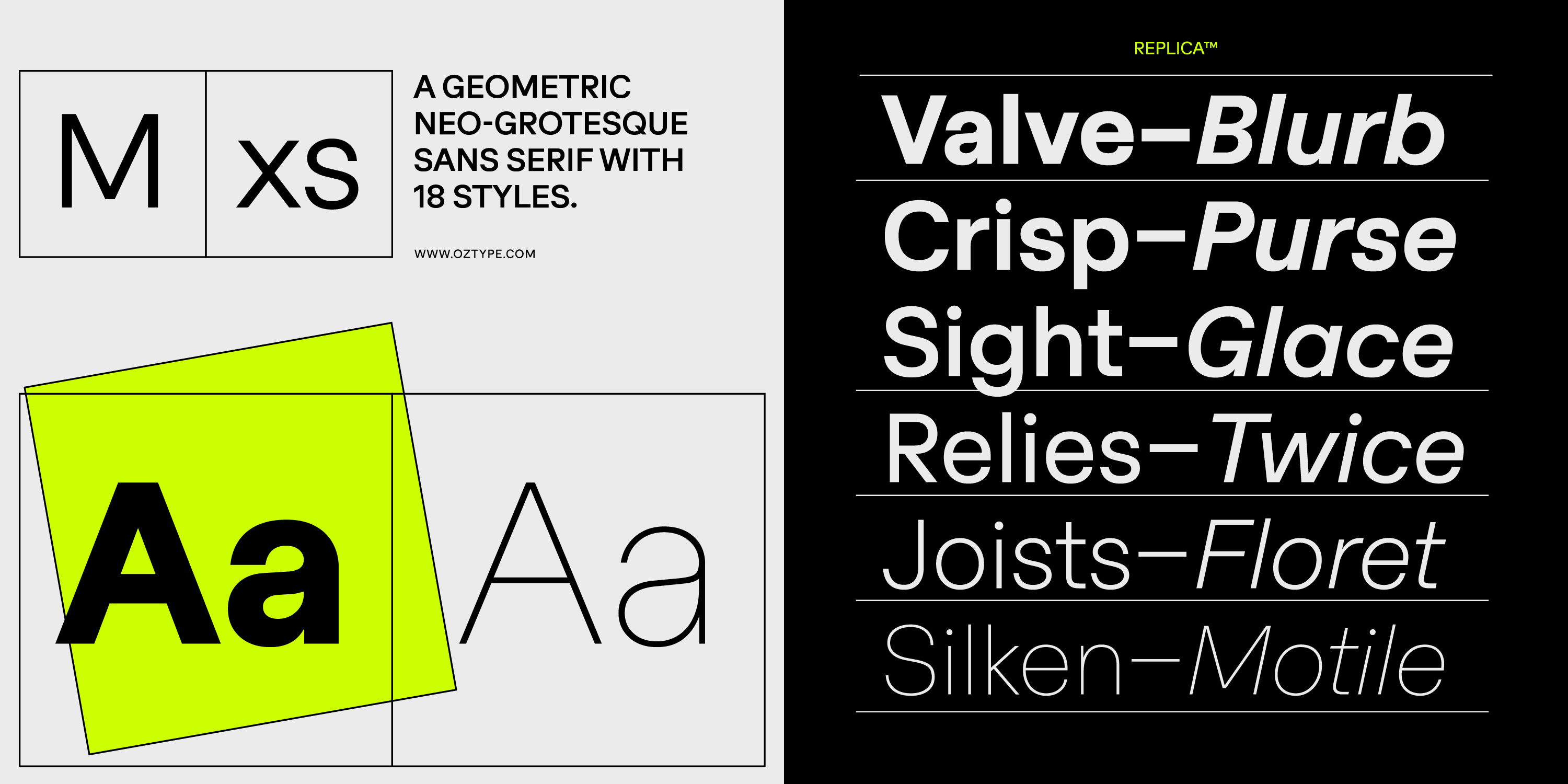
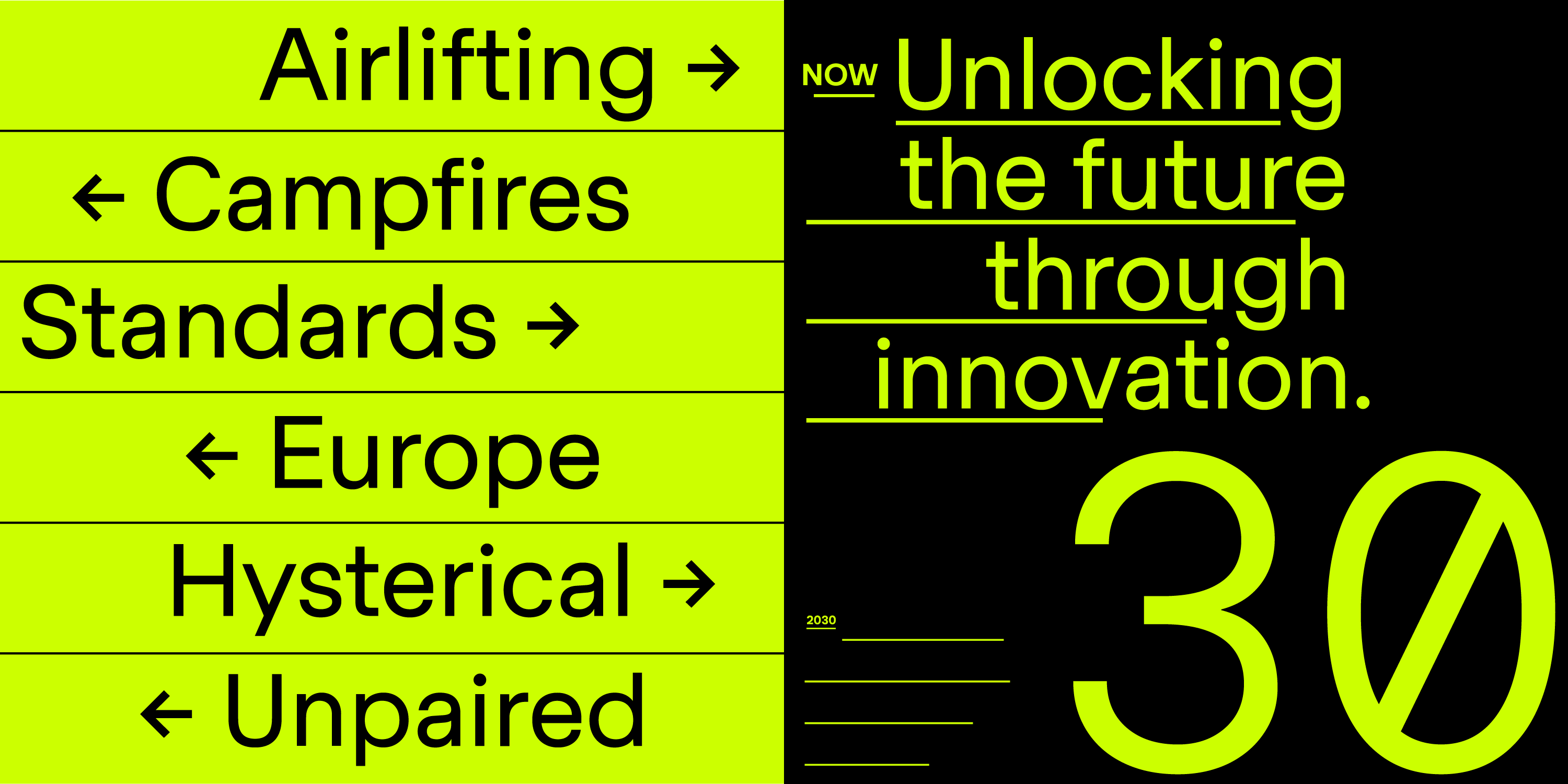
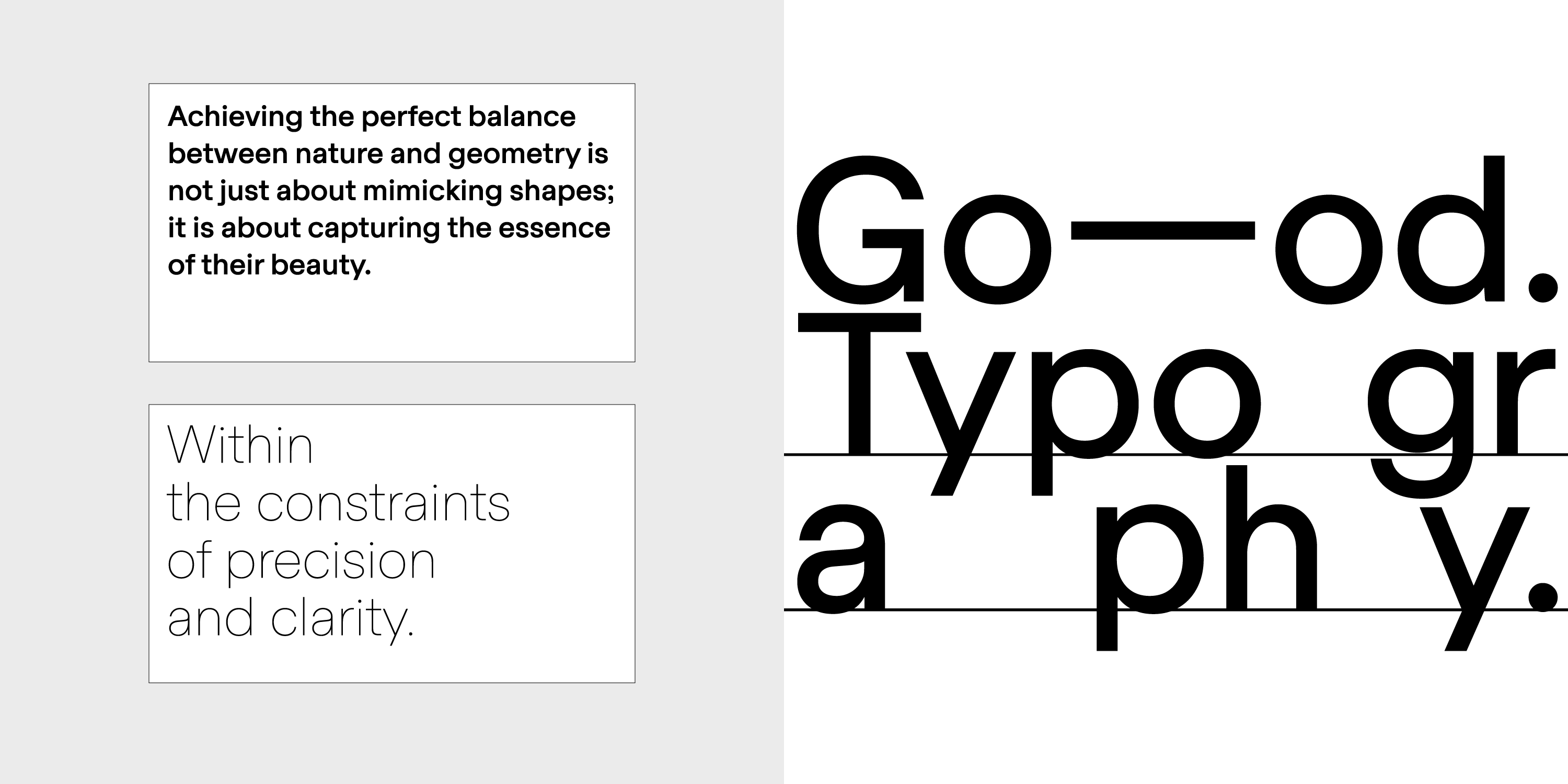
Replica is a captivating geometric grotesque that seamlessly merges biomorphic fluidity with rigid structural geometry. Inspired by the organic design philosophies of Wright and Gaudí, its letterforms translate flowing architectural lines and natural contours into a highly versatile typographic system. This unique harmony makes Replica an arresting choice for display headlines and brand environments, injecting functional layouts with a striking, living presence.

Technical

Metrics

Reading font data…

Axes

Variable axes: Weight (wght) 100–800, Italic (ital) 0–1.

Features

OpenType layout data is included in the font files.

Credits

Designed and released by Oztype in 2023.

Information

2023

Family

OT Replica

Classification
Sans
Styles
18 styles
Format
Variable + static OpenType
Scripts
Latin
Designers
Oussama Horchani, Zachary Schwartz
OT Replica PDF specimen cover
Download PDF specimen
Get trial fonts

About

Replica is a captivating geometric grotesque that seamlessly merges biomorphic fluidity with rigid structural geometry. Inspired by the organic design philosophies of Wright and Gaudí, its letterforms translate flowing architectural lines and natural contours into a highly versatile typographic system. This unique harmony makes Replica an arresting choice for display headlines and brand environments, injecting functional layouts with a striking, living presence.

Specifications

Glyphs
699

Variable axes

Weightwght100 — 800
Italicital0 — 1

OpenType features

Access All Alternatesaalt
Case-Sensitive Formscase
Glyph Composition / Decompositionccmp
Denominatorsdnom
Fractionsfrac
Kerningkern
Standard Ligaturesliga
Lining Figureslnum
Localized Formslocl
Mark Positioningmark
Mark to Mark Positioningmkmk
Numeratorsnumr
Oldstyle Figuresonum
Ordinalsordn
Proportional Figurespnum
Stylistic Alternatessalt
Scientific Inferiorssinf
Lowercase l increased legibilityss01
Single-storey ass02
Geometric lowercase uss03
Geometric lowercase tss04
Geometric Uppercase Gss05
Geometric Ampersand &ss06
Subscriptsubs
Superscriptsups
Tabular Figurestnum
Slashed Zerozero

Supported Languages

131 supported

Latin

  • Afar
  • Afrikaans
  • Aragonese
  • Asu
  • Bemba
  • Bena
  • Bosnian
  • Catalan
  • Cebuano
  • Chiga
  • Corsican
  • Czech
  • Welsh
  • Danish
  • Taita
  • German
  • Lower Sorbian
  • Jola-Fonyi
  • Embu
  • English