OT Tribune

01

Type Tester

Editable
Size280px
Weightwght300
Optical Sizeopsz6
Display Light
Size248px
Leading0.90
Tracking-1
Align
Flow
Porcelain
Weightwght300
Optical Sizeopsz48
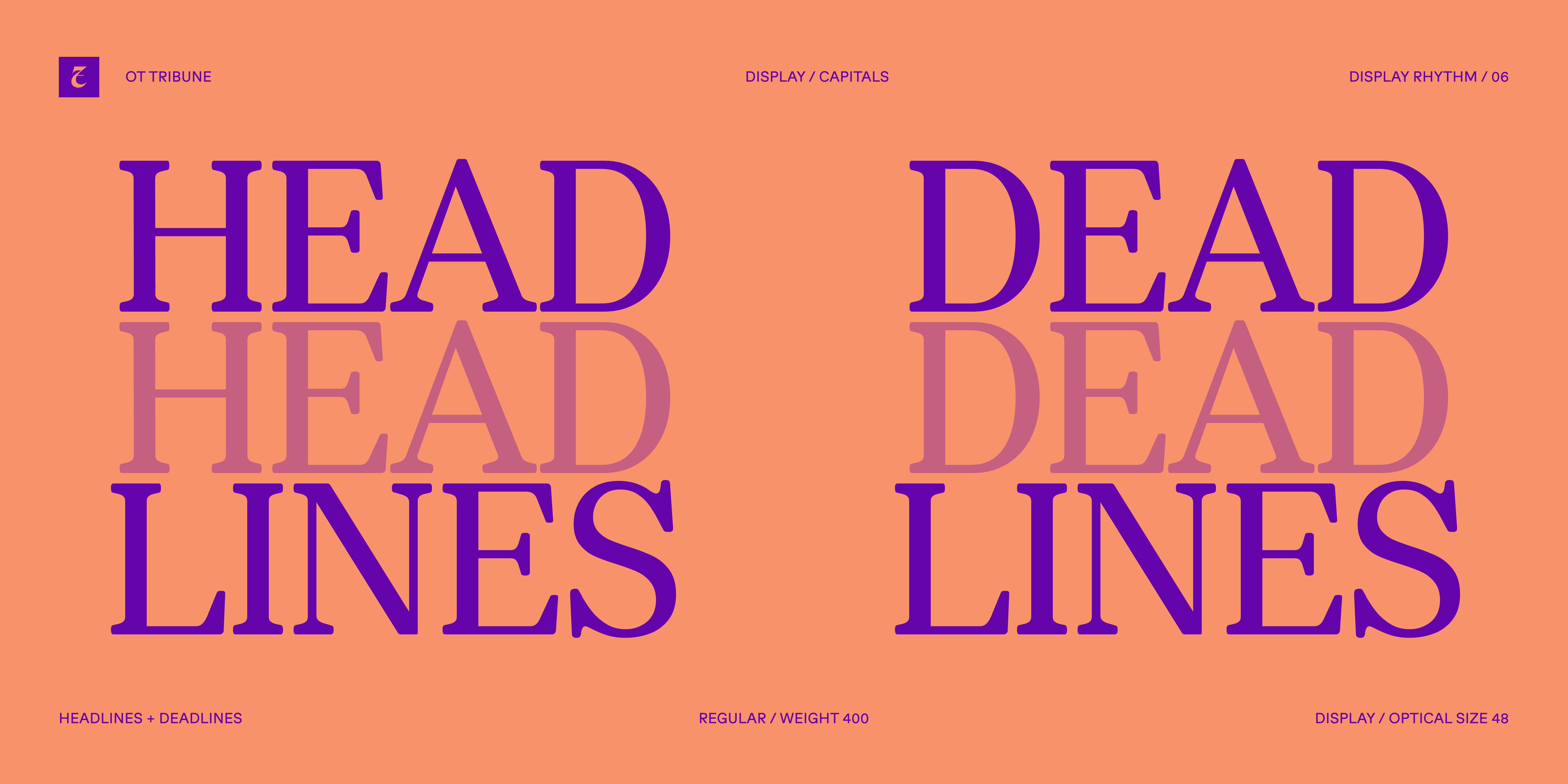
Display Regular
Size217px
Leading0.90
Tracking-1
Align
Flow
Marquetry
Weightwght400
Optical Sizeopsz48
Display Medium
Size171px
Leading0.90
Tracking-1
Align
Flow
Chronometer
Weightwght500
Optical Sizeopsz48
Display Semibold
Size230px
Leading0.90
Tracking-1
Align
Flow
Showcase
Weightwght600
Optical Sizeopsz48
Display Bold
Size184px
Leading0.90
Tracking-1
Align
Flow
Hammerfall
Weightwght700
Optical Sizeopsz48
Display Extrabold
Size191px
Leading0.90
Tracking-1
Align
Flow
Knockdown
Weightwght800
Optical Sizeopsz48

Preview room

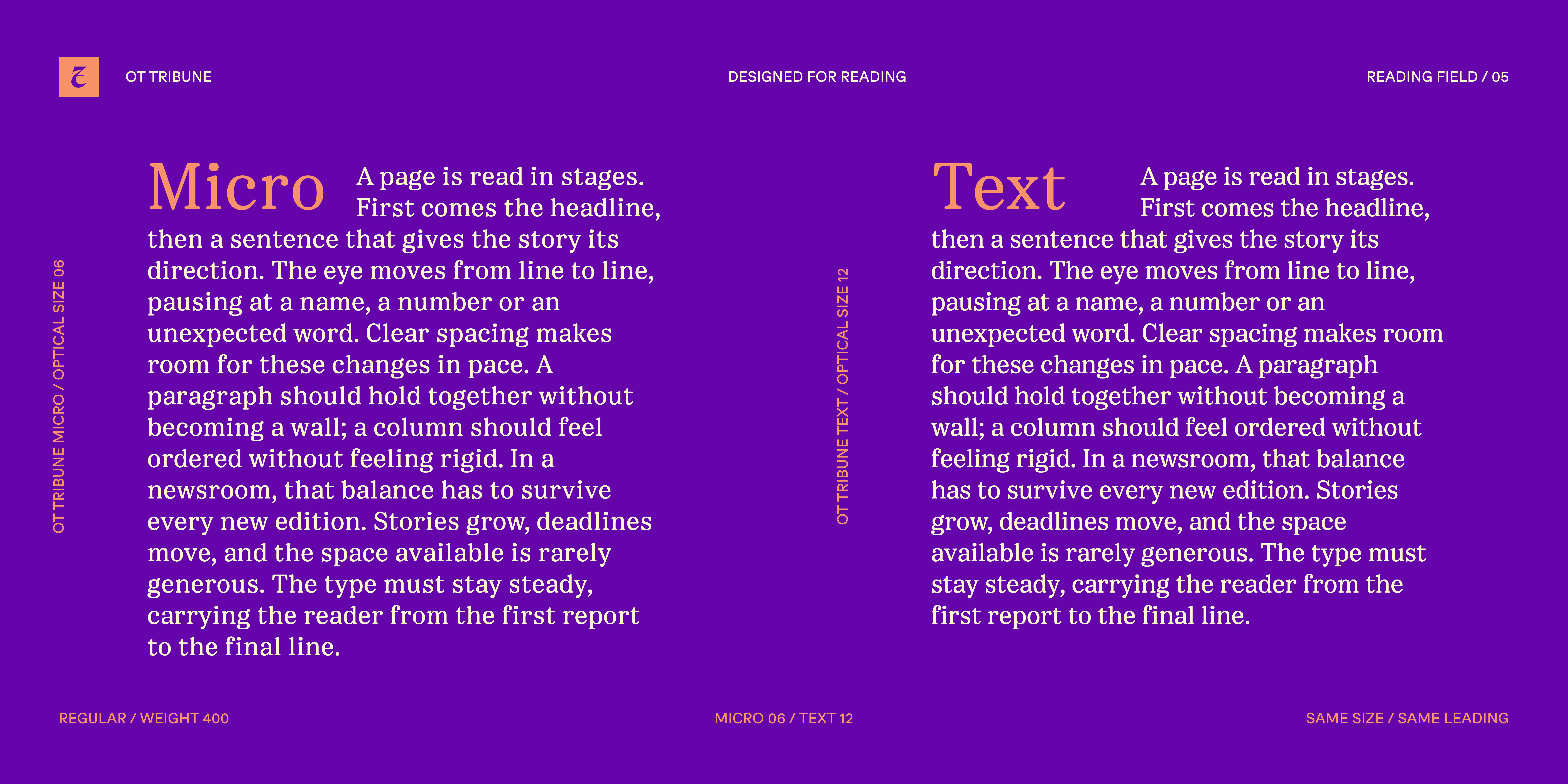
Text Light · 18px · 2 columns
Size18px
Leading1.44
Tracking0
Align
Flow
By the time the preview room opens, every object has already passed through several hands. A porcelain bowl sits beneath a low glass cover, a small bronze is turned so its foundry mark can be seen, and the drawers of a cabinet are left unlocked for supervised viewing. Visitors move differently from shoppers. They compare surfaces, ask for condition reports, return to the same object twice and sometimes bring a reference book of their own. Specialists circulate between tables with gloves, torches and magnifiers, answering questions while keeping the display intact. A faint repair may only appear under raking light; a later mount may explain an unusual proportion; a label beneath a base can send the research in a new direction. Measurements and catalogue notes are checked again when a discrepancy is noticed. The room is temporary, but for a few days it behaves like a working collection, with every object open to comparison and every description still capable of becoming more precise before the sale.
Weightwght300
Optical Sizeopsz12

Preview room

Micro Light · 13px · 3 columns
Size13px
Leading1.50
Tracking0
Align
Flow
By the time the preview room opens, every object has already passed through several hands. A porcelain bowl sits beneath a low glass cover, a small bronze is turned so its foundry mark can be seen, and the drawers of a cabinet are left unlocked for supervised viewing. Visitors move differently from shoppers. They compare surfaces, ask for condition reports, return to the same object twice and sometimes bring a reference book of their own. Specialists circulate between tables with gloves, torches and magnifiers, answering questions while keeping the display intact. A faint repair may only appear under raking light; a later mount may explain an unusual proportion; a label beneath a base can send the research in a new direction. Measurements and catalogue notes are checked again when a discrepancy is noticed. The room is temporary, but for a few days it behaves like a working collection, with every object open to comparison and every description still capable of becoming more precise before the sale.
Weightwght300
Optical Sizeopsz6

Consignment morning

Text Regular · 18px · 2 columns
Size18px
Leading1.44
Tracking0
Align
Flow
Consignment morning begins with crates rather than bids. Objects arrive wrapped in blankets, tissue, fitted cases and improvised cardboard, each carrying a different history of storage and transport. The receiving team checks the intake list before anything is separated from its owner’s paperwork. Measurements are taken, temporary tags are attached and a first set of photographs records the object exactly as received. A specialist may identify a maker immediately, while another piece is set aside for research, translation or a second opinion. Marks are copied carefully rather than guessed from memory, and unusual construction details are photographed before cleaning or handling changes their appearance. By midday the tables hold an unlikely assembly of silver, furniture, books, ceramics and watches. Their only shared quality is that every one of them must be described accurately enough to stand on its own. The early notes may look provisional, but they become the foundation for cataloguing, condition reporting, estimates, packing and the final record of the sale.
Weightwght400
Optical Sizeopsz12

Consignment morning

Micro Regular · 13px · 3 columns
Size13px
Leading1.50
Tracking0
Align
Flow
Consignment morning begins with crates rather than bids. Objects arrive wrapped in blankets, tissue, fitted cases and improvised cardboard, each carrying a different history of storage and transport. The receiving team checks the intake list before anything is separated from its owner’s paperwork. Measurements are taken, temporary tags are attached and a first set of photographs records the object exactly as received. A specialist may identify a maker immediately, while another piece is set aside for research, translation or a second opinion. Marks are copied carefully rather than guessed from memory, and unusual construction details are photographed before cleaning or handling changes their appearance. By midday the tables hold an unlikely assembly of silver, furniture, books, ceramics and watches. Their only shared quality is that every one of them must be described accurately enough to stand on its own. The early notes may look provisional, but they become the foundation for cataloguing, condition reporting, estimates, packing and the final record of the sale.
Weightwght400
Optical Sizeopsz6

Watchmaker’s table

Text Medium · 18px · 2 columns
Size18px
Leading1.44
Tracking0
Align
Flow
On the watchmaker’s table, a chronometer becomes a sequence of small systems. The case is opened, the movement number is recorded and the balance is observed before any adjustment is made. A loupe reveals tool marks around screws, changes in finish and components that may belong to a later service. The dial, hands and crown are considered separately because each can have a different history. Timekeeping is checked over several positions, but a good rate does not erase evidence of replacement or repair. The specialist compares serial numbers, signatures and construction with workshop records where they survive, noting where the evidence agrees and where it remains uncertain. A polished bridge may hide earlier wear; a replacement crystal can alter the profile of the case; a service inscription can establish that the watch travelled farther than its present paperwork suggests. The final report brings these observations together without pretending the object has remained untouched. For a collector, the pattern of maintenance can be as informative as the maker’s signature.
Weightwght500
Optical Sizeopsz12

Watchmaker’s table

Micro Medium · 13px · 3 columns
Size13px
Leading1.50
Tracking0
Align
Flow
On the watchmaker’s table, a chronometer becomes a sequence of small systems. The case is opened, the movement number is recorded and the balance is observed before any adjustment is made. A loupe reveals tool marks around screws, changes in finish and components that may belong to a later service. The dial, hands and crown are considered separately because each can have a different history. Timekeeping is checked over several positions, but a good rate does not erase evidence of replacement or repair. The specialist compares serial numbers, signatures and construction with workshop records where they survive, noting where the evidence agrees and where it remains uncertain. A polished bridge may hide earlier wear; a replacement crystal can alter the profile of the case; a service inscription can establish that the watch travelled farther than its present paperwork suggests. The final report brings these observations together without pretending the object has remained untouched. For a collector, the pattern of maintenance can be as informative as the maker’s signature.
Weightwght500
Optical Sizeopsz6

Bidding desk

Text Semibold · 18px · 2 columns
Size18px
Leading1.44
Tracking0
Align
Flow
Before the auctioneer reaches the first lot, the bidding desk has already processed registrations, identity checks, absentee instructions and telephone requests. Each bidder receives a number linked to a record that staff can verify quickly without exposing private details in the room. Written bids are entered with maximum amounts and checked against lot numbers; telephone lines are assigned and tested; online activity is monitored from a separate screen. During the sale the desk watches for conflicting instructions, missed connections and changes announced from the rostrum. A bidder may increase a limit moments before a lot opens, a phone line may need to be transferred, or an online bid may arrive while the auctioneer is already looking to the room. Every intervention has to be recorded clearly enough to reconstruct afterwards. The work is procedural rather than theatrical, but the accuracy of those records determines whether the result can be confirmed immediately after the hammer falls and whether questions can be answered without relying on memory.
Weightwght600
Optical Sizeopsz12

Bidding desk

Micro Semibold · 13px · 3 columns
Size13px
Leading1.50
Tracking0
Align
Flow
Before the auctioneer reaches the first lot, the bidding desk has already processed registrations, identity checks, absentee instructions and telephone requests. Each bidder receives a number linked to a record that staff can verify quickly without exposing private details in the room. Written bids are entered with maximum amounts and checked against lot numbers; telephone lines are assigned and tested; online activity is monitored from a separate screen. During the sale the desk watches for conflicting instructions, missed connections and changes announced from the rostrum. A bidder may increase a limit moments before a lot opens, a phone line may need to be transferred, or an online bid may arrive while the auctioneer is already looking to the room. Every intervention has to be recorded clearly enough to reconstruct afterwards. The work is procedural rather than theatrical, but the accuracy of those records determines whether the result can be confirmed immediately after the hammer falls and whether questions can be answered without relying on memory.
Weightwght600
Optical Sizeopsz6

Estimate revision

Text Bold · 18px · 2 columns
Size18px
Leading1.44
Tracking0
Align
Flow
An estimate can change when new evidence appears. A maker’s mark may be identified, a comparison may surface in an archive, or a condition issue may prove more significant than it first seemed. The specialist revisits the description, checks recent results and records why the range has moved. Comparable objects are useful only when their differences are understood: scale, material, date, provenance and condition can shift a result as much as the name attached to the catalogue entry. A strong auction result from several years earlier may no longer reflect the market, while a modest price can be misleading if the object was incomplete or badly presented. The purpose of revision is not to manufacture urgency but to keep the catalogue aligned with what is known before the sale begins. When the estimate changes, the internal record should preserve the earlier figure, the new reasoning and the date of the decision. That audit trail allows the department to explain the change later without turning a judgement call into a mystery.
Weightwght700
Optical Sizeopsz12

Estimate revision

Micro Bold · 13px · 3 columns
Size13px
Leading1.50
Tracking0
Align
Flow
An estimate can change when new evidence appears. A maker’s mark may be identified, a comparison may surface in an archive, or a condition issue may prove more significant than it first seemed. The specialist revisits the description, checks recent results and records why the range has moved. Comparable objects are useful only when their differences are understood: scale, material, date, provenance and condition can shift a result as much as the name attached to the catalogue entry. A strong auction result from several years earlier may no longer reflect the market, while a modest price can be misleading if the object was incomplete or badly presented. The purpose of revision is not to manufacture urgency but to keep the catalogue aligned with what is known before the sale begins. When the estimate changes, the internal record should preserve the earlier figure, the new reasoning and the date of the decision. That audit trail allows the department to explain the change later without turning a judgement call into a mystery.
Weightwght700
Optical Sizeopsz6

Collection release

Text Extrabold · 18px · 2 columns
Size18px
Leading1.44
Tracking0
Align
Flow
Release is the final checkpoint in a long chain of records. Payment must be cleared, the buyer or carrier identified, and the correct object matched to the paperwork before anything leaves storage. Staff verify lot numbers against labels and packing records, then note the time and method of collection. For high-value or fragile pieces, photographs may be taken again before handover so the condition at departure is documented. A fitted case can be as important as the object inside it; a detached key, mount or certificate can be easy to overlook if it was stored separately for safety. International shipments add another layer of export papers, customs descriptions and carrier instructions. The process is deliberately repetitive because a single wrong match can be expensive to undo. Strong hierarchy helps the decisive information stay unmistakable at the end of the sale, when many objects are moving at once and the people releasing them may not be the same specialists who catalogued them weeks earlier.
Weightwght800
Optical Sizeopsz12

Collection release

Micro Extrabold · 13px · 3 columns
Size13px
Leading1.50
Tracking0
Align
Flow
Release is the final checkpoint in a long chain of records. Payment must be cleared, the buyer or carrier identified, and the correct object matched to the paperwork before anything leaves storage. Staff verify lot numbers against labels and packing records, then note the time and method of collection. For high-value or fragile pieces, photographs may be taken again before handover so the condition at departure is documented. A fitted case can be as important as the object inside it; a detached key, mount or certificate can be easy to overlook if it was stored separately for safety. International shipments add another layer of export papers, customs descriptions and carrier instructions. The process is deliberately repetitive because a single wrong match can be expensive to undo. Strong hierarchy helps the decisive information stay unmistakable at the end of the sale, when many objects are moving at once and the people releasing them may not be the same specialists who catalogued them weeks earlier.
Weightwght800
Optical Sizeopsz6

Lot heading

Uppercase punctuation alignment
Size64px
Leading1.08
Tracking0
Align
Flow
LOT [214] — ESTIMATE €4,800–€6,200 @ SALEROOM A
Weightwght600
Optical Sizeopsz12

Bid register

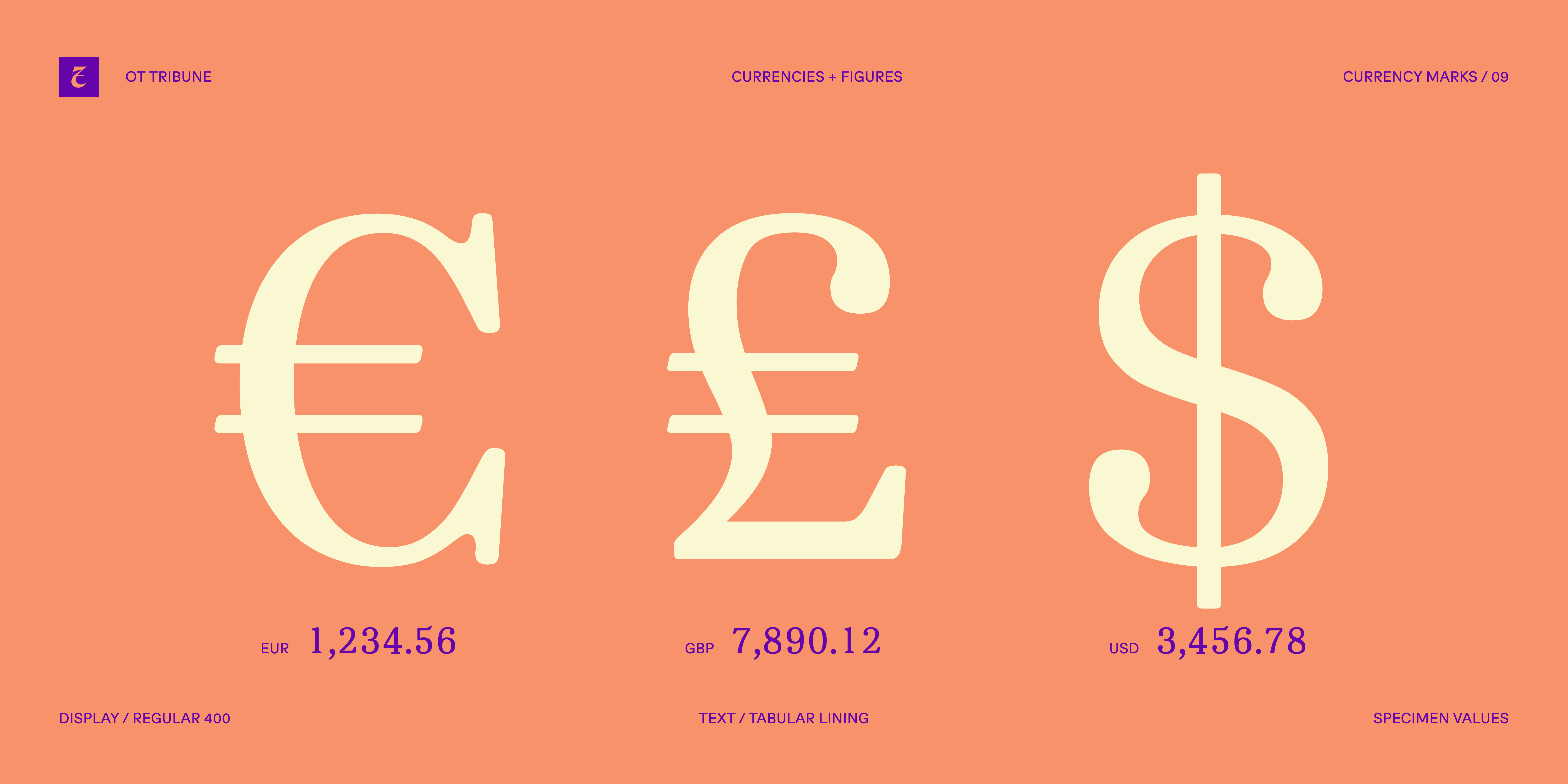
Tabular figures
Size58px
Leading1.08
Tracking0
Align
Flow
LOT 017 €4,800 LOT 204 €12,500 LOT 611 €95,000 LOT 842 €120,000
Weightwght400
Optical Sizeopsz12

Ownership dates

Oldstyle figures
Size64px
Leading1.08
Tracking0
Align
Flow
Acquired 1898 · catalogued 1912 · restored 1966 · sold 2004
Weightwght400
Optical Sizeopsz12

Object dimensions

Composed fractional measures
Size64px
Leading1.08
Tracking0
Align
Flow
Height 12 1/2 in · Width 8 3/4 in · Dial 4 1/8 in
Weightwght400
Optical Sizeopsz12

Cabinet order

Ordinals
Size64px
Leading1.08
Tracking0
Align
Flow
1st cabinet · 2nd tray · 3rd case · 4th drawer
Weightwght500
Optical Sizeopsz12

Condition notes

Superscript figures
Size64px
Leading1.08
Tracking0
Align
Flow
Frame1 · Dial2 · Movement3 · Case4
Weightwght400
Optical Sizeopsz12

Dagger annotation

Character variant 01
Size64px
Leading1.08
Tracking0
Align
Flow
† Restored clasp · † Replaced crystal · † Later case
Weightwght500
Optical Sizeopsz12

Scheda d’opera

Italiano
Size52px
Leading1.15
Tracking0
Align
Flow
La scheda registra materiali, misure, marchi e restauri prima che il lotto entri in sala.
Weightwght400
Optical Sizeopsz12

Vista previa

Español
Size52px
Leading1.15
Tracking0
Align
Flow
Antes de la subasta, cada pieza se examina de cerca y las observaciones se añaden al informe de estado.
Weightwght400
Optical Sizeopsz12

Visningsdag

Svenska
Size52px
Leading1.15
Tracking0
Align
Flow
Inför auktionen står föremålen framme för visning, medan specialisterna svarar på frågor om skick och proveniens.
Weightwght400
Optical Sizeopsz12
02

Glyph Map

Loading Micro Light…
AU+0041
100%
Glyph name
—
Unicode
U+0041
Decimal
65
Advance
—
Sidebearings
—
01/08

Specimens

2:1
OT Tribune: OT Tribune editorial marks specimen
04

Information

2026

Family

OT Tribune

Serif
18 styles
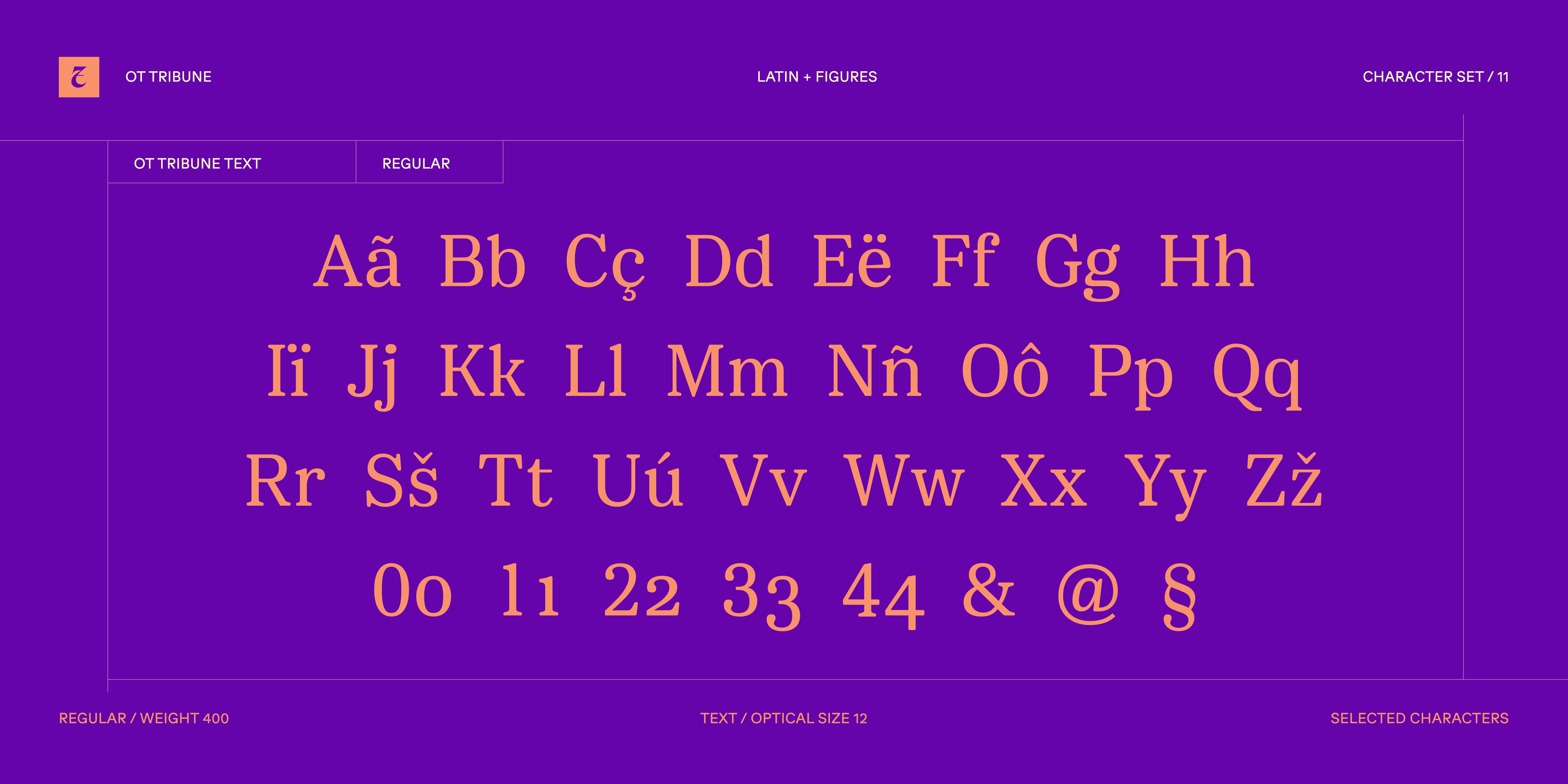
Latin, Latin Extended
Released 2026

Variable and static OpenType formats.

OT Tribune

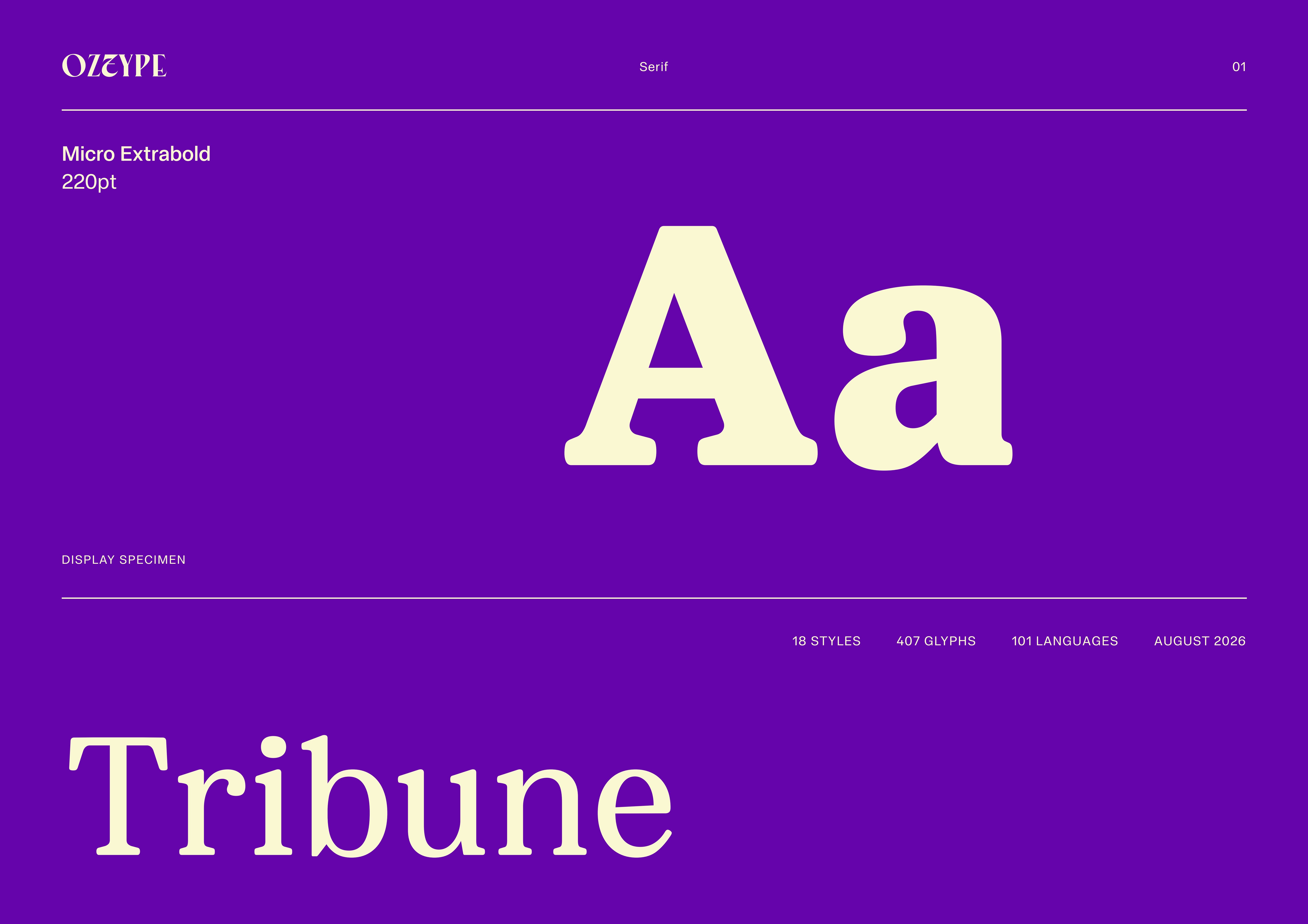
OT Tribune is an authoritative editorial serif system engineered with a strict vertical axis and crisp, bracketed serifs for mechanical layout discipline. Operating as a flexible variable family, it features tailored optical cuts—from wide-aperture Micro styles optimized for low-resolution screens to tight-tracking Display weights that maximize high-contrast tension. Highly pragmatic and unsentimental, it provides the robust typographic infrastructure required for complex data, newsrooms, and contemporary branding.

Technical

Metrics

Reading font data…

Axes

Variable axes: Weight (wght) 300–800, Optical Size (opsz) 6–48.

Features

OpenType layout data is included in the font files.

Credits

Designed and released by Oztype in 2026.

Information

2026

Family

OT Tribune

Classification
Serif
Styles
18 styles
Format
Variable + static OpenType
Scripts
Latin, Latin Extended
Designers
Oussama Horchani, Zachary Schwartz
OT Tribune PDF specimen cover
Download PDF specimen
Get trial fonts

About

OT Tribune is an authoritative editorial serif system engineered with a strict vertical axis and crisp, bracketed serifs for mechanical layout discipline. Operating as a flexible variable family, it features tailored optical cuts—from wide-aperture Micro styles optimized for low-resolution screens to tight-tracking Display weights that maximize high-contrast tension. Highly pragmatic and unsentimental, it provides the robust typographic infrastructure required for complex data, newsrooms, and contemporary branding.

Specifications

Glyphs
407

Variable axes

Weightwght300 — 800
Optical Sizeopsz6 — 48

OpenType features

Case-Sensitive Formscase
Character Variant 01cv01
Denominatorsdnom
Fractionsfrac
Kerningkern
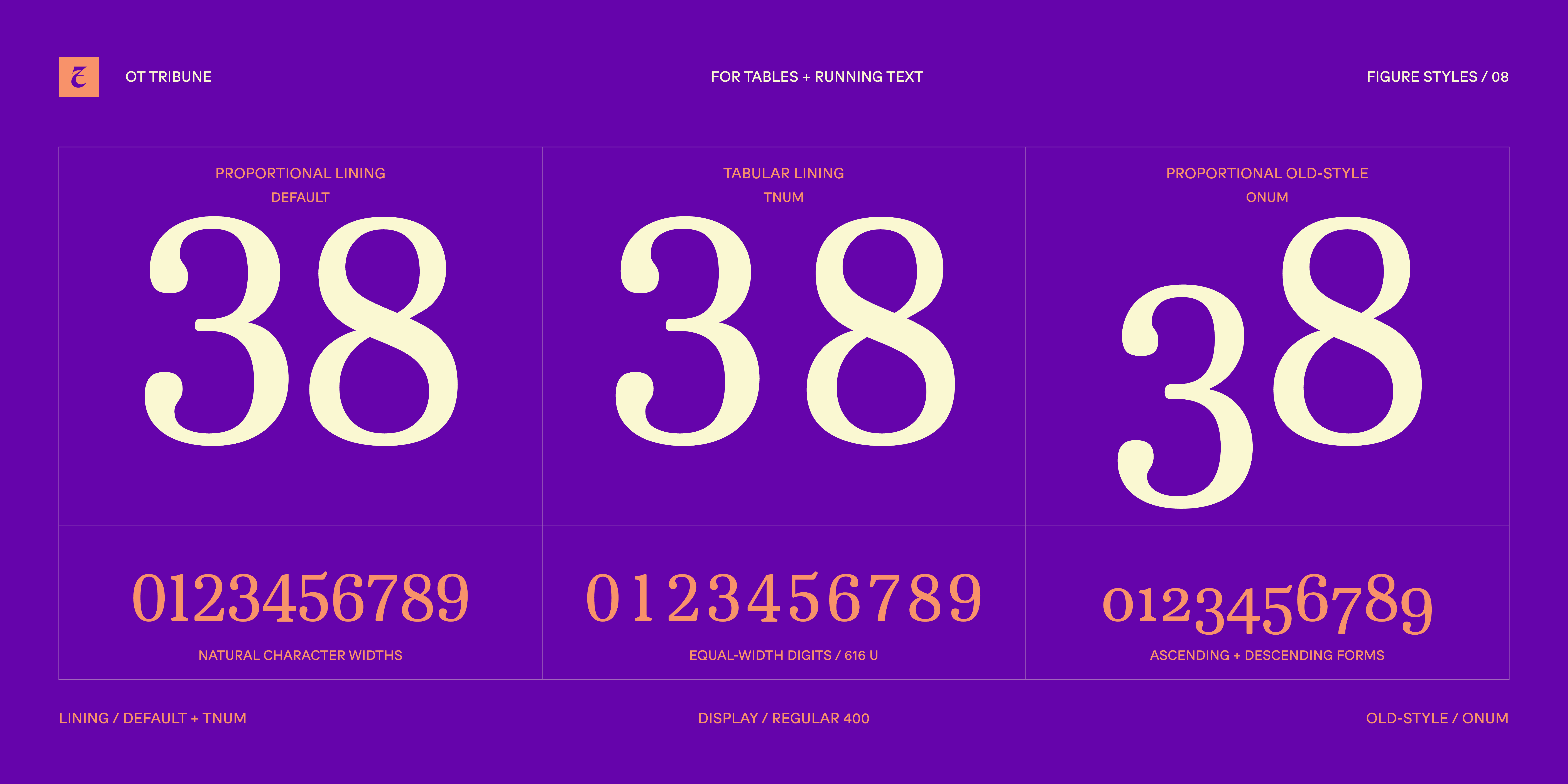
Lining Figureslnum
Numeratorsnumr
Oldstyle Figuresonum
Ordinalsordn
Proportional Figurespnum
Required Variation Alternatesrvrn
Stylistic Alternatessalt
Scientific Inferiorssinf
Subscriptsubs
Superscriptsups
Tabular Figurestnum

Supported Languages

101 supported

Latin · Latin Extended

  • Afar
  • Afrikaans
  • Aragonese
  • Asu
  • Bemba
  • Bena
  • Bosnian
  • Catalan
  • Cebuano
  • Chiga
  • Corsican
  • Welsh
  • Danish
  • Taita
  • German
  • English
  • Spanish
  • Estonian
  • Basque
  • Finnish